
Manufacturing
Can three good station yields still hide a poor first-time-through result?
Trace one starting cohort through three assembly stations and distinguish conditional first-time yield from rework returning to the line.
Start with the original serial numbers and follow only those still passing first time. Multiplying three station percentages gives an interpretable first-time-through result when each percentage is conditional on that same clean cohort reaching the next station. Mixing repaired units back into later denominators changes the question.
Follow 100 original assemblies
At station one, 95 of 100 assemblies pass first time. Of those 95, 91 pass station two at the first attempt. Of those 91, 87 pass station three without intervention. The conditional yields are 95%, about 95.79% and about 95.60%. Their product is exactly 87% before rounding: the intermediate denominators cancel. Thirteen original units experienced at least one interruption.

Worked data
Process position | First-time cohort entering | Still first-time through |
Start | 100 | 100 |
After station 1 | 100 | 95 |
After station 2 | 95 | 91 |
After station 3 | 91 | 87 |
Download the figures in this worked example (CSV)
When the production report is answering a different question
A reworked assembly may re-enter station two and pass that visit. It is a valid completed visit, but it cannot restore that serial number’s first-time history. A system keyed only to transaction events may record more passes than original units. Retain a unit identifier, station, attempt number and disposition.
For a bottleneck review, the repeat visits are valuable because they consume machine and operator time. Report them beside the cohort result. For a shipment review, use final accepted units. The measures describe different costs: service delivered to customers, work returned to the line, and untouched first-pass flow. A single “yield” column cannot reliably serve all three.
Sources
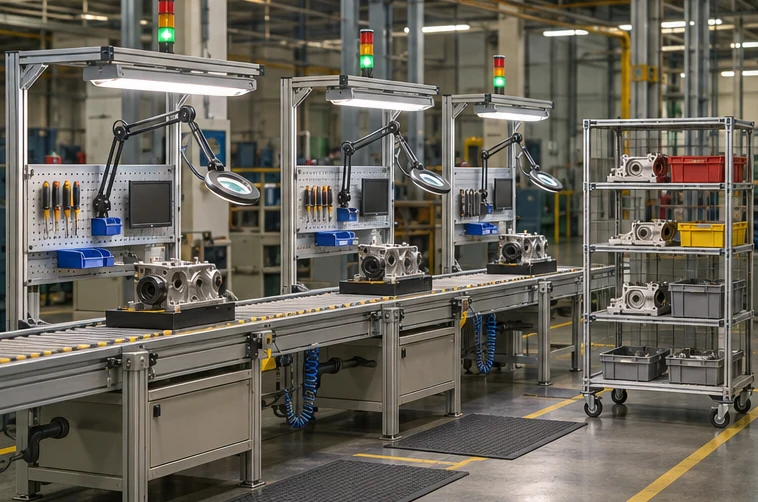
Cover illustration by Industry Applied, generated with AI. Assembly workstations and a separate rework area.
Related reading
Start with the original serial numbers and follow only those still passing first time. Multiplying three station percentages gives an interpretable first-time-through result when each percentage is conditional on that same clean cohort reaching the next station. Mixing repaired units back into later denominators changes the question.
Follow 100 original assemblies
At station one, 95 of 100 assemblies pass first time. Of those 95, 91 pass station two at the first attempt. Of those 91, 87 pass station three without intervention. The conditional yields are 95%, about 95.79% and about 95.60%. Their product is exactly 87% before rounding: the intermediate denominators cancel. Thirteen original units experienced at least one interruption.
Worked data
Process position | First-time cohort entering | Still first-time through |
Start | 100 | 100 |
After station 1 | 100 | 95 |
After station 2 | 95 | 91 |
After station 3 | 91 | 87 |
Download the figures in this worked example (CSV)
When the production report is answering a different question
A reworked assembly may re-enter station two and pass that visit. It is a valid completed visit, but it cannot restore that serial number’s first-time history. A system keyed only to transaction events may record more passes than original units. Retain a unit identifier, station, attempt number and disposition.
For a bottleneck review, the repeat visits are valuable because they consume machine and operator time. Report them beside the cohort result. For a shipment review, use final accepted units. The measures describe different costs: service delivered to customers, work returned to the line, and untouched first-pass flow. A single “yield” column cannot reliably serve all three.
Sources
Cover illustration by Industry Applied, generated with AI. Assembly workstations and a separate rework area.