
Manufacturing
A coolroom door opened less often. Did the dispatch change help?
Compare total open time with pallet movements before attributing an improvement to a new cold-store dispatch routine.
Count door-open minutes alongside the work completed. A quieter shift can produce fewer openings without improving the handling routine. Conversely, fewer openings can make the coldroom worse if each one takes much longer. A magnetic contact gives you the duration of the activity that matters to the doors review.
Rebuild two shifts from their event logs
On an illustrative New Zealand cold-store shift, staff transfer 80 pallets in 40 openings averaging 45 seconds. That is 30 open minutes, or 22.5 seconds per pallet. On a later shift they transfer 60 pallets in 25 openings averaging 60 seconds. The door is open for 25 minutes, but the rate has risen to 25 seconds per pallet. Total exposure fell while handling per pallet slowed.

Worked data
Shift | Open minutes / pallets | Open seconds per pallet |
Initial | 30 / 80 | 22.5 |
Later | 25 / 60 | 25 |
Download the figures in this worked example (CSV)
Locate the long openings
Pair each open edge with its close edge. A record open at the end of a shift belongs partly to the next shift. Flag missing edges for inspection. Split ordinary transfers from cleaning, maintenance access and a door left open while stock was being found. A plan for grouping pallets will help one of those causes and do little for the others.
The EECA industrial refrigeration guide discusses reducing infiltration and managing doors. Open time is a proxy for that investigation, not a measured refrigeration energy saving. Outside humidity and temperature, pressure differences, curtain condition and simultaneous loading all change the heat and moisture entering the room. Use matched weather and activity periods, plus electrical or refrigeration measurements, before putting a kWh value against a dispatch change.
Sources
New Zealand EECA · Good practice guide to industrial refrigeration
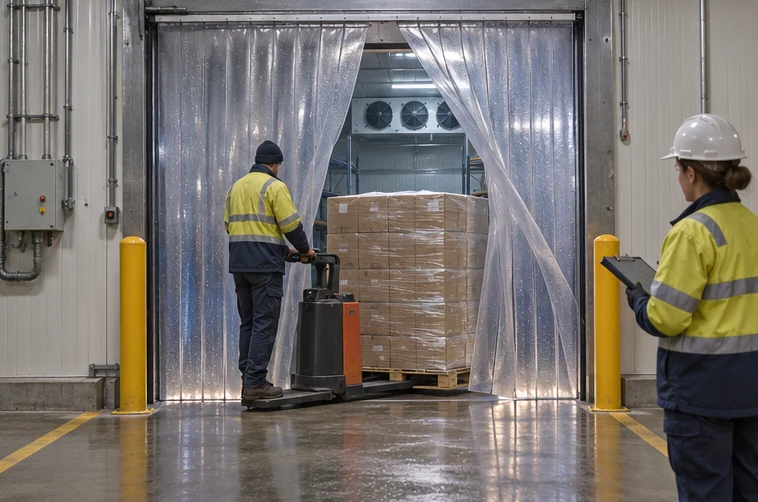
Cover illustration by Industry Applied, generated with AI. A pallet being moved through a coolroom door.
Related reading
Count door-open minutes alongside the work completed. A quieter shift can produce fewer openings without improving the handling routine. Conversely, fewer openings can make the coldroom worse if each one takes much longer. A magnetic contact gives you the duration of the activity that matters to the doors review.
Rebuild two shifts from their event logs
On an illustrative New Zealand cold-store shift, staff transfer 80 pallets in 40 openings averaging 45 seconds. That is 30 open minutes, or 22.5 seconds per pallet. On a later shift they transfer 60 pallets in 25 openings averaging 60 seconds. The door is open for 25 minutes, but the rate has risen to 25 seconds per pallet. Total exposure fell while handling per pallet slowed.
Worked data
Shift | Open minutes / pallets | Open seconds per pallet |
Initial | 30 / 80 | 22.5 |
Later | 25 / 60 | 25 |
Download the figures in this worked example (CSV)
Locate the long openings
Pair each open edge with its close edge. A record open at the end of a shift belongs partly to the next shift. Flag missing edges for inspection. Split ordinary transfers from cleaning, maintenance access and a door left open while stock was being found. A plan for grouping pallets will help one of those causes and do little for the others.
The EECA industrial refrigeration guide discusses reducing infiltration and managing doors. Open time is a proxy for that investigation, not a measured refrigeration energy saving. Outside humidity and temperature, pressure differences, curtain condition and simultaneous loading all change the heat and moisture entering the room. Use matched weather and activity periods, plus electrical or refrigeration measurements, before putting a kWh value against a dispatch change.
Sources
New Zealand EECA · Good practice guide to industrial refrigeration
Cover illustration by Industry Applied, generated with AI. A pallet being moved through a coolroom door.