
Manufacturing
Why a boiler returning 80% of its steam still needs 23 tonnes of make-up
Draw the boundary around the feedtank and boiler. The steam that does not return and the water leaving through blowdown both require replacement.
Returning 80 tonnes of condensate from 100 tonnes of steam leaves 20 tonnes of steam-side losses or uses. If the boiler also discharged 3 tonnes of blowdown during the same period, replacement water is 23 tonnes at steady inventory. A make-up meter showing 23 tonnes can agree with an 80% condensate-return figure.
Build the two balances in order
Assume no change in boiler or feedtank storage and no other inlets or outlets. The boiler needs 103 tonnes of feedwater to produce 100 tonnes of steam and discharge 3 tonnes through blowdown. The feedtank receives 80 tonnes of returned condensate, so the remaining 23 must be make-up. A plant that calls 80/103 its “return percentage” will report 77.7%. A plant dividing by steam production will report 80%. Both ratios require a denominator on the report.

Worked data
Blowdown case | Boiler blowdown (t) | Make-up required (t) |
Low | 1 | 21 |
Example | 3 | 23 |
Higher | 5 | 25 |
Download the figures in this worked example (CSV)
Trace unexplained make-up
Look at feedtank level at both ends of the interval. A rising tank consumes make-up without immediately appearing in steam output. Check whether a second boiler shares the supply meter and whether flash steam is measured or vented. Reconcile masses on one basis. Hot condensate volume cannot be equated to cold make-up volume at arbitrary temperatures without a density conversion.
Returning hot condensate has energy and water-treatment value, which the US Department of Energy describes in its steam tip sheet. The balance here estimates replacement mass. To put a value on recovered heat, measure the return temperature and define the alternative make-up condition. The water meter alone cannot supply that second answer.
Sources
US Department of Energy · Return condensate to the boiler
US Department of Energy · Cooling tower water efficiency
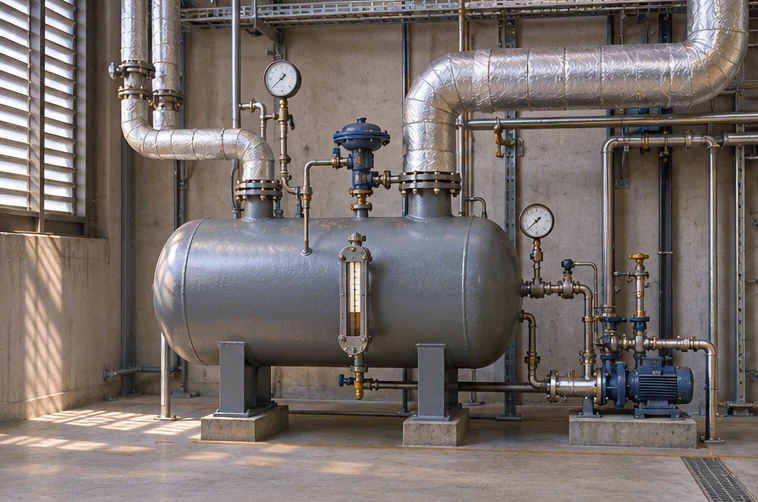
Cover illustration by Industry Applied, generated with AI. Condensate receiver and insulated return pipes.
Related reading
Returning 80 tonnes of condensate from 100 tonnes of steam leaves 20 tonnes of steam-side losses or uses. If the boiler also discharged 3 tonnes of blowdown during the same period, replacement water is 23 tonnes at steady inventory. A make-up meter showing 23 tonnes can agree with an 80% condensate-return figure.
Build the two balances in order
Assume no change in boiler or feedtank storage and no other inlets or outlets. The boiler needs 103 tonnes of feedwater to produce 100 tonnes of steam and discharge 3 tonnes through blowdown. The feedtank receives 80 tonnes of returned condensate, so the remaining 23 must be make-up. A plant that calls 80/103 its “return percentage” will report 77.7%. A plant dividing by steam production will report 80%. Both ratios require a denominator on the report.
Worked data
Blowdown case | Boiler blowdown (t) | Make-up required (t) |
Low | 1 | 21 |
Example | 3 | 23 |
Higher | 5 | 25 |
Download the figures in this worked example (CSV)
Trace unexplained make-up
Look at feedtank level at both ends of the interval. A rising tank consumes make-up without immediately appearing in steam output. Check whether a second boiler shares the supply meter and whether flash steam is measured or vented. Reconcile masses on one basis. Hot condensate volume cannot be equated to cold make-up volume at arbitrary temperatures without a density conversion.
Returning hot condensate has energy and water-treatment value, which the US Department of Energy describes in its steam tip sheet. The balance here estimates replacement mass. To put a value on recovered heat, measure the return temperature and define the alternative make-up condition. The water meter alone cannot supply that second answer.
Sources
US Department of Energy · Return condensate to the boiler
US Department of Energy · Cooling tower water efficiency
Cover illustration by Industry Applied, generated with AI. Condensate receiver and insulated return pipes.