
Manufacturing
When does a smaller carton actually change the freight weight?
Compare two boxes for a 2 kg instrument using Australia Post’s published cubing example and calculate the point at which a smaller box stops reducing chargeable weight.
A smaller box can take a parcel out of cubic pricing, but only down to the parcel’s actual packed weight. Australia Post explains a cubic conversion of 250 kg per cubic metre for services where cubing applies. With that factor a 2 kg parcel crosses over at 0.008 m³, or eight litres. Below that volume, actual weight is already the larger number.
Follow the units from bench to booking
Take an illustrative instrument in protective packaging. Carton A measures 40 × 30 × 20 cm. Convert each length to metres before multiplying. Its volume is 0.024 m³, giving a cubic weight of 6 kg. Carton B measures 30 × 20 × 15 cm. Its 0.009 m³ gives 2.25 kg. If packed weight remains 2 kg, B still cubes above actual mass, but only by a quarter of a kilogram.

Worked data
Outer carton (cm) | Cubic weight (kg) | Higher weight (kg) |
40 × 30 × 20 | 6.00 | 6.00 |
30 × 20 × 15 | 2.25 | 2.25 |
25 × 20 × 15 | 1.875 | 2.00 |
Download the figures in this worked example (CSV)
Turn an apparent saving into a packing decision
A 25 × 20 × 15 cm carton has a 1.875 kg cubic weight. It still rates at 2 kg under the comparison. Further size reductions may improve storage but deliver no further reduction in that input to the freight charge. The carrier’s price bands can also make two different rating weights cost the same.
Check the current product, account terms, dimensional limits and any own-packaging or flat-rate arrangements before pricing an order. Weigh the actual parcel after adding cushioning. If a smaller carton exposes a sensor connector or optical face to impact, compare a different protective insert or orientation. The worthwhile carton is the smallest tested pack that protects the instrument and changes the real booking outcome.
Where a carton trial can mislead
One instrument might weigh 2 kg packed with its standard probe and 2.7 kg with a spare cable set. In Carton B the first variant is assessed on 2.25 kg under the example rule. The second is assessed on 2.7 kg. The same packing change can therefore affect two catalogue configurations by different amounts. Select a light configuration and a heavy configuration for the trial and record the packaged mass for each.
Consider a month with 30 shipments of the light configuration. Switching from 6 kg to 2.25 kg reduces the sum of rating weights by 112.5 kg. That does not produce a dollar saving until the carrier’s zone, service, rate table and price bands are applied shipment by shipment. One remote journey may contribute more to the bill than several local journeys of the same weight. Use actual destination groups for the commercial comparison and keep component protection as a separate acceptance check.
The most reproducible packing record includes an external three-axis measurement, actual gross mass, carrier service, carton code and transport-test result. A later packaging change can then be compared with the original without having to reconstruct what “small box” meant.
Sources
Australia Post · How to calculate cubic weight
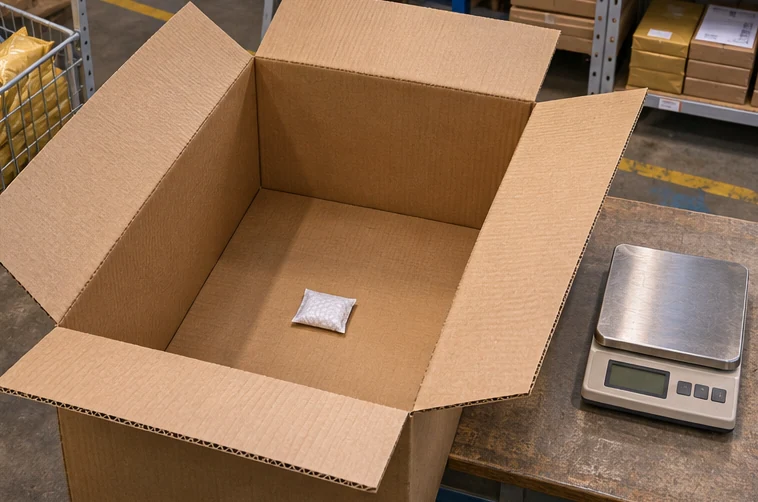
Cover illustration by Industry Applied, generated with AI. A small instrument inside an oversized parcel.
A smaller box can take a parcel out of cubic pricing, but only down to the parcel’s actual packed weight. Australia Post explains a cubic conversion of 250 kg per cubic metre for services where cubing applies. With that factor a 2 kg parcel crosses over at 0.008 m³, or eight litres. Below that volume, actual weight is already the larger number.
Follow the units from bench to booking
Take an illustrative instrument in protective packaging. Carton A measures 40 × 30 × 20 cm. Convert each length to metres before multiplying. Its volume is 0.024 m³, giving a cubic weight of 6 kg. Carton B measures 30 × 20 × 15 cm. Its 0.009 m³ gives 2.25 kg. If packed weight remains 2 kg, B still cubes above actual mass, but only by a quarter of a kilogram.
Worked data
Outer carton (cm) | Cubic weight (kg) | Higher weight (kg) |
40 × 30 × 20 | 6.00 | 6.00 |
30 × 20 × 15 | 2.25 | 2.25 |
25 × 20 × 15 | 1.875 | 2.00 |
Download the figures in this worked example (CSV)
Turn an apparent saving into a packing decision
A 25 × 20 × 15 cm carton has a 1.875 kg cubic weight. It still rates at 2 kg under the comparison. Further size reductions may improve storage but deliver no further reduction in that input to the freight charge. The carrier’s price bands can also make two different rating weights cost the same.
Check the current product, account terms, dimensional limits and any own-packaging or flat-rate arrangements before pricing an order. Weigh the actual parcel after adding cushioning. If a smaller carton exposes a sensor connector or optical face to impact, compare a different protective insert or orientation. The worthwhile carton is the smallest tested pack that protects the instrument and changes the real booking outcome.
Where a carton trial can mislead
One instrument might weigh 2 kg packed with its standard probe and 2.7 kg with a spare cable set. In Carton B the first variant is assessed on 2.25 kg under the example rule. The second is assessed on 2.7 kg. The same packing change can therefore affect two catalogue configurations by different amounts. Select a light configuration and a heavy configuration for the trial and record the packaged mass for each.
Consider a month with 30 shipments of the light configuration. Switching from 6 kg to 2.25 kg reduces the sum of rating weights by 112.5 kg. That does not produce a dollar saving until the carrier’s zone, service, rate table and price bands are applied shipment by shipment. One remote journey may contribute more to the bill than several local journeys of the same weight. Use actual destination groups for the commercial comparison and keep component protection as a separate acceptance check.
The most reproducible packing record includes an external three-axis measurement, actual gross mass, carrier service, carton code and transport-test result. A later packaging change can then be compared with the original without having to reconstruct what “small box” meant.
Sources
Australia Post · How to calculate cubic weight
Cover illustration by Industry Applied, generated with AI. A small instrument inside an oversized parcel.