
Manufacturing
Which warehouse lighting zone is worth putting on occupancy control?
One zone has fewer fittings yet offers the larger saving. Logged empty hours change which retrofit deserves a trial.
Put the first occupancy-control trial where lighting power overlaps with genuinely unoccupied time. A large, busy aisle can offer less avoidable energy than a small packing annex that stays lit after dispatch finishes. Counting luminaires alone misses that distinction.
Read the two zones as different jobs
An example main aisle has 30 fittings drawing 60 W each. A week of observations identifies ten hours when the full zone could have been off. That is 1.8 kW × 10 h, or 18 kWh. The annex has 12 fittings at 50 W, but 45 suitable hours, giving 27 kWh. The annex has only a third of the aisle’s connected load and still has the larger opportunity.

Worked data
Lighting zone | Connected load and vacancy | Avoidable energy (kWh) |
Main aisle | 1.8 kW × 10 h | 18 |
Packing annex | 0.6 kW × 45 h | 27 |
Download the figures in this worked example (CSV)
Check the last person out
Walk the area with the shift supervisor. Cleaning, despatch paperwork and maintenance can occur long after the last pallet move. Combine door records or occupancy observations with lighting power. An empty aisle on a security camera cannot tell you which other fittings are wired to its circuit.
If the annex must dim to a measured 15% of full power, the indicated saving becomes 27 × 0.85 = 22.95 kWh. Longer switch-off delays reduce it again. Log representative nights before and after the trial and compare like shifts. The Australian Government lighting guide discusses zoning, controls and daylight. Emergency lighting and required illumination must remain within the site’s approved lighting design.
Sources
Australian Government · Lighting equipment guide
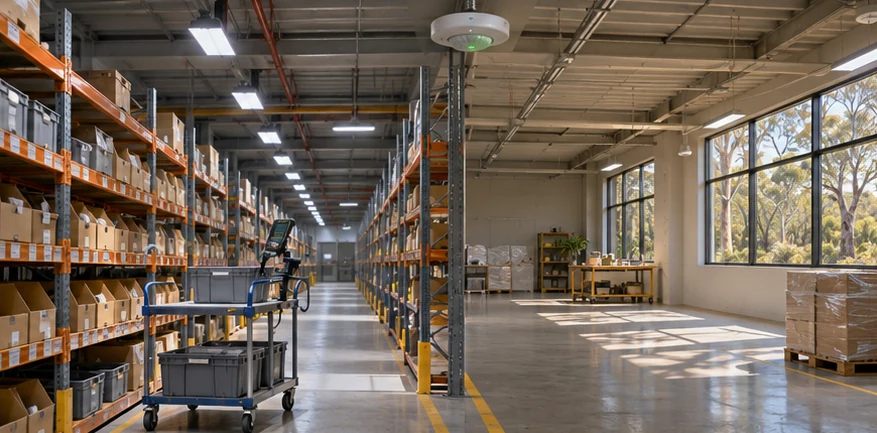
Cover illustration by Industry Applied, generated with AI. A lit warehouse picking aisle beside an empty aisle.
Put the first occupancy-control trial where lighting power overlaps with genuinely unoccupied time. A large, busy aisle can offer less avoidable energy than a small packing annex that stays lit after dispatch finishes. Counting luminaires alone misses that distinction.
Read the two zones as different jobs
An example main aisle has 30 fittings drawing 60 W each. A week of observations identifies ten hours when the full zone could have been off. That is 1.8 kW × 10 h, or 18 kWh. The annex has 12 fittings at 50 W, but 45 suitable hours, giving 27 kWh. The annex has only a third of the aisle’s connected load and still has the larger opportunity.
Worked data
Lighting zone | Connected load and vacancy | Avoidable energy (kWh) |
Main aisle | 1.8 kW × 10 h | 18 |
Packing annex | 0.6 kW × 45 h | 27 |
Download the figures in this worked example (CSV)
Check the last person out
Walk the area with the shift supervisor. Cleaning, despatch paperwork and maintenance can occur long after the last pallet move. Combine door records or occupancy observations with lighting power. An empty aisle on a security camera cannot tell you which other fittings are wired to its circuit.
If the annex must dim to a measured 15% of full power, the indicated saving becomes 27 × 0.85 = 22.95 kWh. Longer switch-off delays reduce it again. Log representative nights before and after the trial and compare like shifts. The Australian Government lighting guide discusses zoning, controls and daylight. Emergency lighting and required illumination must remain within the site’s approved lighting design.
Sources
Australian Government · Lighting equipment guide
Cover illustration by Industry Applied, generated with AI. A lit warehouse picking aisle beside an empty aisle.