
Manufacturing
The carton fits the shelf on paper. Can the picker actually get it in?
A 20 mm allowance can change the number of cartons that fit across a shelf. Check orientation and the measured opening before changing a slotting plan.
Use the measured clear opening and the packed envelope to test shelf capacity. In a 1,180 mm opening, three boxes at 390 mm each appear to fit, with just 10 mm left in total. A local handling allowance of 20 mm for the row would reduce the usable width to 1,160 mm. That apparently tiny difference removes a whole carton position.
Try the two permitted faces
An example box is 390 mm wide and 280 mm deep. Across the 1,160 mm working width it fits twice on its long dimension, or four times on its short dimension. The second orientation consumes 390 mm of shelf depth. A shelf with only 360 mm of usable depth cannot accept it under a no-overhang rule. Of the two patterns, the less impressive two-wide layout is the one the geometry supports.

Worked data
Arrangement | Width test | Positions across |
Nominal long face | 1,180 ÷ 390 | 3 |
Long face with allowance | 1,160 ÷ 390 | 2 |
Short face with allowance | 1,160 ÷ 280 | 4 |
Download the figures in this worked example (CSV)
Record a usable pick face
Inspect the narrowest point, including uprights, labels and projecting dividers. Check the packed case near its widest point and confirm that labels face the aisle in the selected orientation. GS1’s trade-item measurement rules give warehouse master-data teams a common way to record dimensions. The physical opening and permitted handling orientation remain local measurements.
This is a carton-footprint exercise. Load ratings, handling clearances and any safety or fire requirements come from the actual storage system and site procedures. Use a normal, unopened carton for fit checks in an authorised location. Record whether a picker can remove the end case without first emptying the adjacent slot. That observation can outweigh the extra facing promised by a theoretical floor plan.
Sources
GS1 · Package and Product Measurement Standard
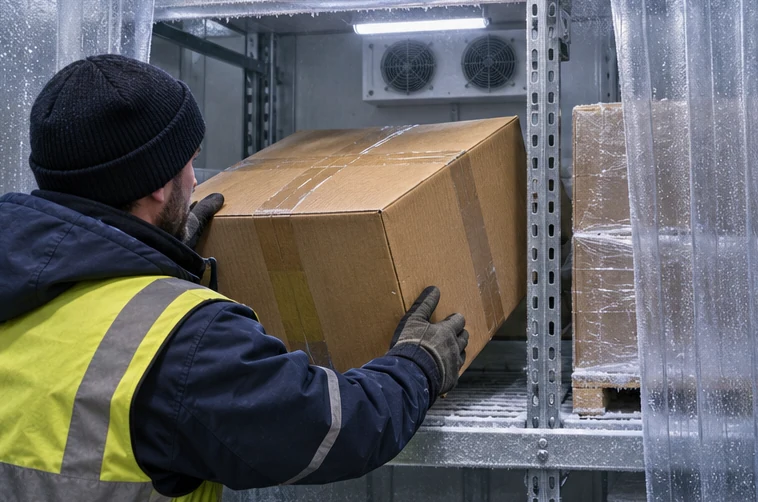
Cover illustration by Industry Applied, generated with AI. Testing the orientation of a case at a shelf opening.
Use the measured clear opening and the packed envelope to test shelf capacity. In a 1,180 mm opening, three boxes at 390 mm each appear to fit, with just 10 mm left in total. A local handling allowance of 20 mm for the row would reduce the usable width to 1,160 mm. That apparently tiny difference removes a whole carton position.
Try the two permitted faces
An example box is 390 mm wide and 280 mm deep. Across the 1,160 mm working width it fits twice on its long dimension, or four times on its short dimension. The second orientation consumes 390 mm of shelf depth. A shelf with only 360 mm of usable depth cannot accept it under a no-overhang rule. Of the two patterns, the less impressive two-wide layout is the one the geometry supports.
Worked data
Arrangement | Width test | Positions across |
Nominal long face | 1,180 ÷ 390 | 3 |
Long face with allowance | 1,160 ÷ 390 | 2 |
Short face with allowance | 1,160 ÷ 280 | 4 |
Download the figures in this worked example (CSV)
Record a usable pick face
Inspect the narrowest point, including uprights, labels and projecting dividers. Check the packed case near its widest point and confirm that labels face the aisle in the selected orientation. GS1’s trade-item measurement rules give warehouse master-data teams a common way to record dimensions. The physical opening and permitted handling orientation remain local measurements.
This is a carton-footprint exercise. Load ratings, handling clearances and any safety or fire requirements come from the actual storage system and site procedures. Use a normal, unopened carton for fit checks in an authorised location. Record whether a picker can remove the end case without first emptying the adjacent slot. That observation can outweigh the extra facing promised by a theoretical floor plan.
Sources
GS1 · Package and Product Measurement Standard
Cover illustration by Industry Applied, generated with AI. Testing the orientation of a case at a shelf opening.