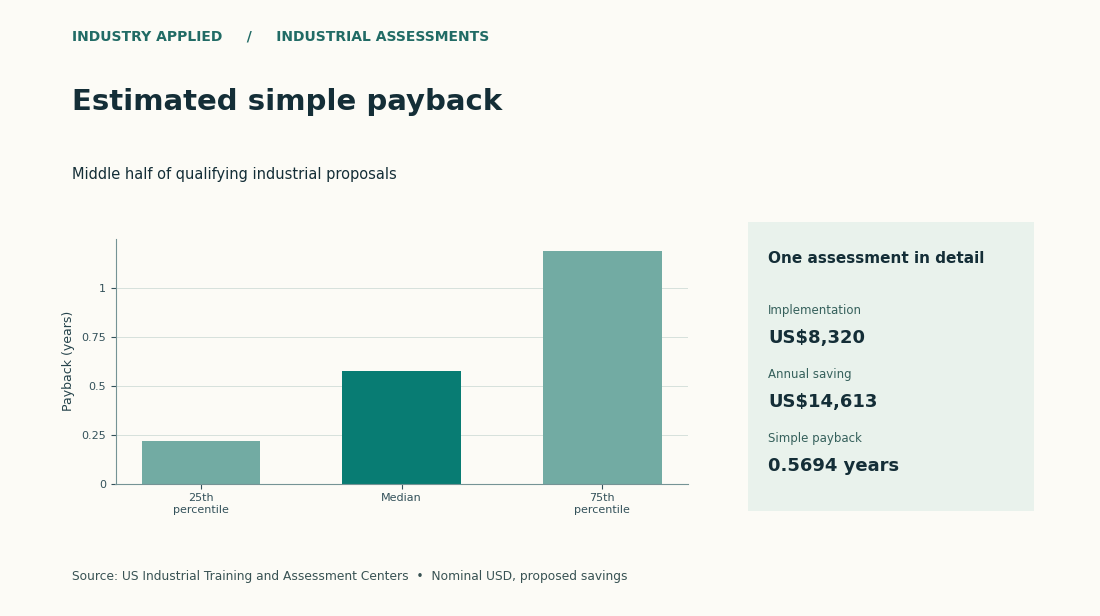
Across 134 qualifying US industrial recommendations, the median projected simple payback was 0.5741 years. The middle half ran from 0.2151 to 1.19 years. Those figures describe the assessed proposals for keeping doors and windows shut when not on use, in fiscal years 1982 to 2026.
The scope of the plant change
Match the generation profile to on-site use and separately value any export. Preserve the tariff period and record curtailed or unavailable hours. Equipment cost alone leaves the balance-of-system works and the connection boundary out of the estimate.
A recommendation you can reproduce
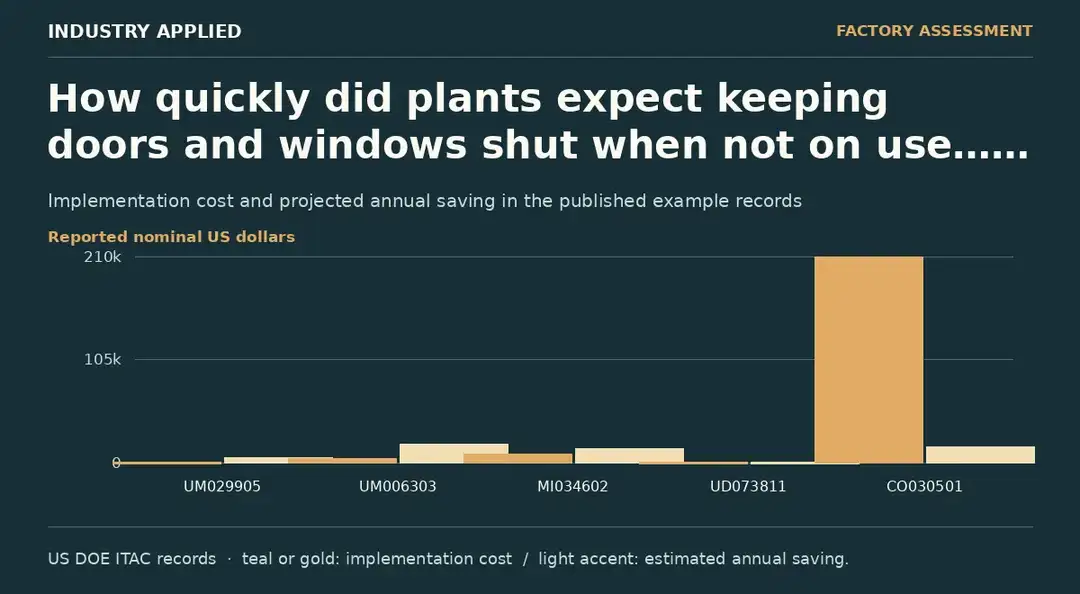
Recommendation MI034602 in US fiscal year 2019 pairs US$8,320 of implementation cost with US$14,613 in estimated annual net savings. Dividing the first figure by the second gives 0.5694 years. This record was selected by proximity to the median payback, with the more recent assessment preferred when ratios tie.
The median implementation cost was US$1,000 and the median annual saving was US$2,494. Those two medians can come from different facilities. To obtain the payback distribution, divide cost by annual savings within each recommendation and take percentiles of the resulting years. Zero-cost measures remain in the calculation. The table selects actual records at five ordered positions, so its rounded examples can differ slightly from interpolated percentiles.
What the records can support
The source lists 230 recommendations under assessment code 2.7442. The analysis retains records with a reported fiscal year, a non-negative implementation cost and positive net annual monetary savings. It sums the reported primary, secondary, tertiary and quaternary dollar savings, preserving recorded costs or offsets. A missing savings field contributes nothing only when at least one resource has a recorded value.
Of the 134 comparable records, 76 carry the implemented flag and 44 the non-implemented flag. The remaining 14 have another or unreported status. These are administrative outcomes. They do not establish the saving subsequently measured at an individual plant.
How the assessment mix affects the comparison
For fiscal years 1980–1999, 39 qualifying records had a median of 0.5401 years. For fiscal years 2000–2014, 48 qualifying records had a median of 0.7328 years. For fiscal years 2015–2026, 47 qualifying records had a median of 0.5107 years. Grouping by year changes the mix of facilities and proposals. The medians are descriptive, and the database does not establish a causal trend over time.
Worked data
Recommendation ID | US fiscal year | Implementation cost (USD) | Estimated annual net saving (USD) | Recalculated payback (years) |
|---|---|---|---|---|
UM029905 | 2006 | 25 | 5156 | 0.00484872 |
UM006303 | 1996 | 4000 | 18800 | 0.212766 |
MI034602 | 2019 | 8320 | 14613 | 0.5693561 |
UD073811 | 2006 | 459 | 382 | 1.201571 |
CO030501 | 1994 | 210000 | 16210 | 12.95497 |
Using the evidence in an Australian project
For the worked record, delivering only three quarters of its estimated annual saving would give 0.7591 years. At full forecast savings and a 20% higher installed cost, it would give 0.6832 years. These are sensitivity calculations using the same original proposal. A local business case needs quotations and a current Australian tariff or material price.
Run the local comparison over the same production duty in both cases. Keep a separate column for incentives, scheduled replacement and avoided maintenance so that the engineering change can be evaluated at both full and incremental cost.
Sources and calculation files
The assessment-code results and the US Industrial Training and Assessment Centers database download contain the original recommendations. Dollar amounts are nominal US dollars for the assessment year. The Australian Government equipment guides provide local context. Download the worked records as CSV.