
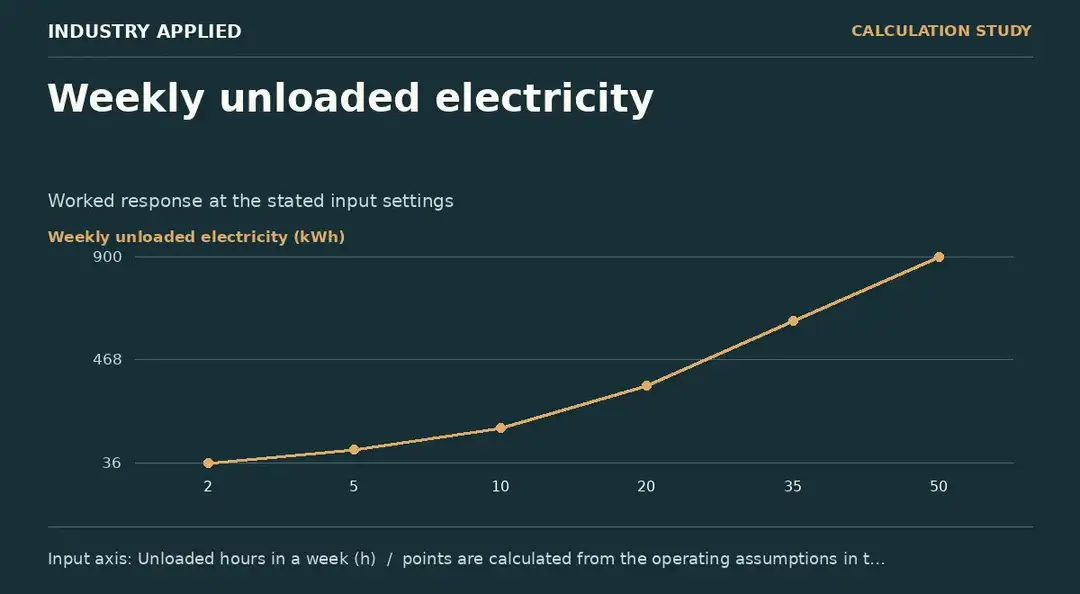
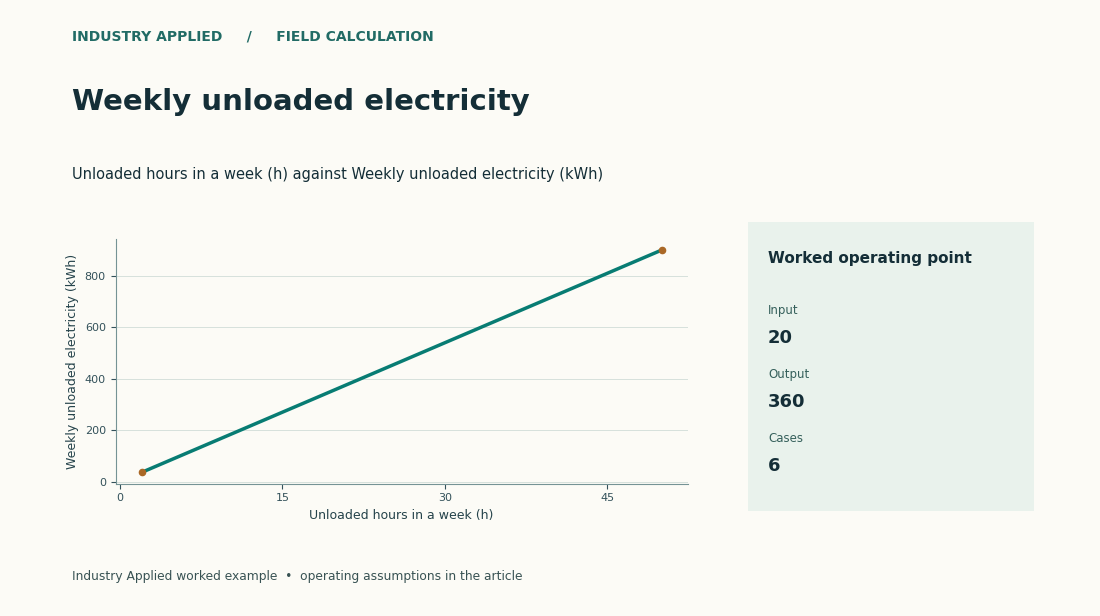
Multiply metered unloaded input of 18 kW by the logged unloaded hours. In the worked example, Unloaded hours in a week of 20 h gives weekly unloaded electricity of 360 kWh.
Set up the field measurement
Capture actual input during unload cycles after the blowdown transient. Control mode and discharge pressure affect the power required even at low delivered flow. Keep the reference observation alongside the calculation, with the instrument identification, observation period and units. This makes it possible for the next shift to distinguish a new operating condition from a change in how the observation was recorded.
Two operating points
At 10 h the calculated weekly unloaded electricity is 180 kWh. At 20 h it is 360 kWh. Subtracting the first output from the second gives 180 kWh. These values give two independent checkpoints for a spreadsheet or a logger conversion.
Worked data
Unloaded hours in a week (h) | Weekly unloaded electricity (kWh) |
|---|---|
2 | 36 |
5 | 90 |
10 | 180 |
20 | 360 |
35 | 630 |
50 | 900 |
Checking the working range
At the two ends of the example, an input of 2 gives 36 and an input of 50 gives 900. Use a value near each end to check your implementation. Testing only the middle row can conceal an incorrect offset, an inverted ratio or a unit conversion applied twice.
Interpreting the result
Motor nameplate power is a poor substitute for unloaded input. Use interval readings that resolve the control cycle. If measured performance sits outside the worked range, first repeat the comparison using field inputs and the same boundary. Preserve the original reading in the export. A discrepancy is easier to investigate when the field observation and the calculated output occupy separate columns.
Source and calculation data
For the underlying measurement context, see the US Department of Energy compressed-air sourcebook. The operating values and sensitivity analysis here are an Industry Applied worked example. Download the input and output values to verify the calculation with the values from your own site.