
Manufacturing
A bulging carton quietly adds a cubic metre to the freight plan
Measuring the packed outer case can reveal a material freight-volume error even when the supplier’s flat carton specification looks right.
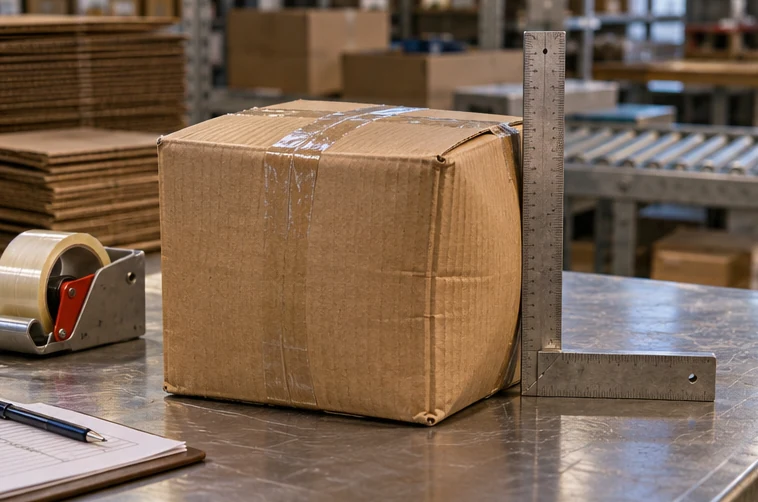
Measure the carton as it travels. A nominal 400 × 300 × 250 mm case occupies 0.030 m³. If the packed case bows out to 320 mm across its widest point, the rectangular shipping envelope becomes 0.032 m³. The extra two litres sounds trivial until a despatch plan repeats the case 500 times. The difference is a full cubic metre.
Establish which object the dimensions describe
The flat carton blank, an empty erected case and a filled closed case are three different objects. GS1’s package measurement standard sets out how to orient and measure items for master data. Match the packaging level and measurement conventions used by your trading partner. Record where the widest part lies, including any persistent bulge. Photograph the three axes with the case sitting in its normal condition.

Worked data
Packed cases | Extra volume per case (m³) | Extra envelope volume (m³) |
1 | 0.002 | 0.002 |
100 | 0.002 | 0.2 |
250 | 0.002 | 0.5 |
500 | 0.002 | 1.0 |
Download the figures in this worked example (CSV)
Decide whether the master record should change
Measure cases from several normal production runs. A single crushed corner suggests damage handling. A recurring bulge at the seam suggests the nominal dimensions understate the shipped case. Keep observations from the lower pallet layers separate if stacking changes the shape.
The rectangular envelope does not establish actual vehicle utilisation. Pallet layout, stack height, interlocking patterns and load restraints can impose tighter limits. For a carrier dispute, identify the consignment, service and measurement convention used by the carrier. For a racking decision, measure the loaded envelope and the clear opening. Together these checks explain how the same carton can fit a spreadsheet, overflow a pallet pattern and still meet its nominal packaging specification.
Sources
GS1 · Package and Product Measurement Standard
Cover illustration by Industry Applied, generated with AI. Checking a packed carton against a square.
Measure the carton as it travels. A nominal 400 × 300 × 250 mm case occupies 0.030 m³. If the packed case bows out to 320 mm across its widest point, the rectangular shipping envelope becomes 0.032 m³. The extra two litres sounds trivial until a despatch plan repeats the case 500 times. The difference is a full cubic metre.
Establish which object the dimensions describe
The flat carton blank, an empty erected case and a filled closed case are three different objects. GS1’s package measurement standard sets out how to orient and measure items for master data. Match the packaging level and measurement conventions used by your trading partner. Record where the widest part lies, including any persistent bulge. Photograph the three axes with the case sitting in its normal condition.
Worked data
Packed cases | Extra volume per case (m³) | Extra envelope volume (m³) |
1 | 0.002 | 0.002 |
100 | 0.002 | 0.2 |
250 | 0.002 | 0.5 |
500 | 0.002 | 1.0 |
Download the figures in this worked example (CSV)
Decide whether the master record should change
Measure cases from several normal production runs. A single crushed corner suggests damage handling. A recurring bulge at the seam suggests the nominal dimensions understate the shipped case. Keep observations from the lower pallet layers separate if stacking changes the shape.
The rectangular envelope does not establish actual vehicle utilisation. Pallet layout, stack height, interlocking patterns and load restraints can impose tighter limits. For a carrier dispute, identify the consignment, service and measurement convention used by the carrier. For a racking decision, measure the loaded envelope and the clear opening. Together these checks explain how the same carton can fit a spreadsheet, overflow a pallet pattern and still meet its nominal packaging specification.
Sources
GS1 · Package and Product Measurement Standard
Cover illustration by Industry Applied, generated with AI. Checking a packed carton against a square.