
Manufacturing
Five sieve masses, one grading curve: which column is percent passing?
Rebuild a 1 kg aggregate grading result from mass retained on each sieve. Cumulative retention is the step that prevents a reversed grading curve.
Percent passing at a sieve is the fraction that got through that sieve. Calculate the cumulative mass retained on that sieve and on all coarser sieves, divide by the test mass, and subtract from 100%. Using only the material lying on the individual sieve gives the wrong curve.
Follow a one-kilogram test portion
For illustration, 120 g stays on a 9.5 mm sieve, 280 g on 4.75 mm, 350 g on 2.36 mm and 200 g on 1.18 mm. The pan collects 50 g. The recovered materials total 1,000 g. At 4.75 mm the cumulative retained mass is 120 + 280 = 400 g, so 60% passes. At 2.36 mm cumulative retained reaches 750 g and only 25% passes.

Worked data
Sieve opening | Individual retained mass (g) | Passing (%) |
9.5 mm | 120 | 88 |
4.75 mm | 280 | 60 |
2.36 mm | 350 | 25 |
1.18 mm | 200 | 5 |
Download the figures in this worked example (CSV)
The pan is a useful independent check
The last passing value is 5%. In this example, the measured pan contains 50 g, which is also 5% of the original 1,000 g. If the two do not agree, check transcription, zeroing and sample loss. Re-normalising every column to the recovered total can hide an unexpectedly large mass discrepancy, so retain the original test mass.
Iowa DOT’s IM 302 is a published worked-method reference for gradation. Australian and New Zealand contracts may specify a different test method, sieve sizes, preparation or reporting precision. This calculation explains the arithmetic, not acceptance against a particular road specification. Use the designated method and size envelope when deciding whether a delivered aggregate meets the job requirement.
Sources
Iowa Department of Transportation · Sieve analysis of aggregates, IM 302
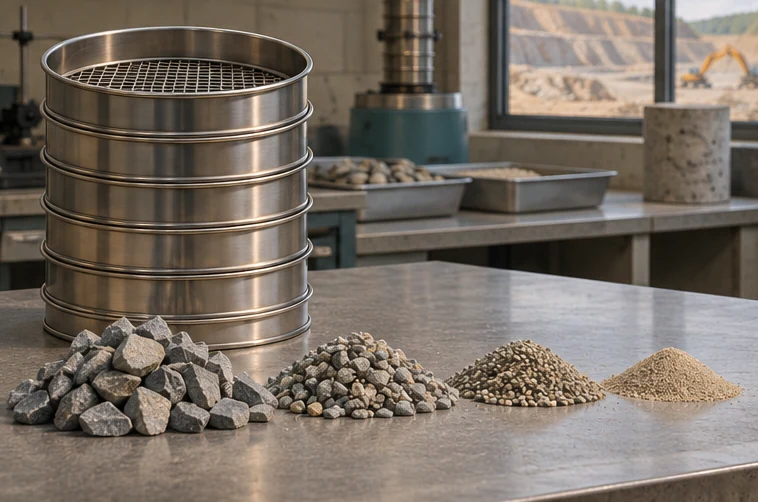
Cover illustration by Industry Applied, generated with AI. Laboratory aggregate sieves and size-separated material.
Percent passing at a sieve is the fraction that got through that sieve. Calculate the cumulative mass retained on that sieve and on all coarser sieves, divide by the test mass, and subtract from 100%. Using only the material lying on the individual sieve gives the wrong curve.
Follow a one-kilogram test portion
For illustration, 120 g stays on a 9.5 mm sieve, 280 g on 4.75 mm, 350 g on 2.36 mm and 200 g on 1.18 mm. The pan collects 50 g. The recovered materials total 1,000 g. At 4.75 mm the cumulative retained mass is 120 + 280 = 400 g, so 60% passes. At 2.36 mm cumulative retained reaches 750 g and only 25% passes.
Worked data
Sieve opening | Individual retained mass (g) | Passing (%) |
9.5 mm | 120 | 88 |
4.75 mm | 280 | 60 |
2.36 mm | 350 | 25 |
1.18 mm | 200 | 5 |
Download the figures in this worked example (CSV)
The pan is a useful independent check
The last passing value is 5%. In this example, the measured pan contains 50 g, which is also 5% of the original 1,000 g. If the two do not agree, check transcription, zeroing and sample loss. Re-normalising every column to the recovered total can hide an unexpectedly large mass discrepancy, so retain the original test mass.
Iowa DOT’s IM 302 is a published worked-method reference for gradation. Australian and New Zealand contracts may specify a different test method, sieve sizes, preparation or reporting precision. This calculation explains the arithmetic, not acceptance against a particular road specification. Use the designated method and size envelope when deciding whether a delivered aggregate meets the job requirement.
Sources
Iowa Department of Transportation · Sieve analysis of aggregates, IM 302
Cover illustration by Industry Applied, generated with AI. Laboratory aggregate sieves and size-separated material.