
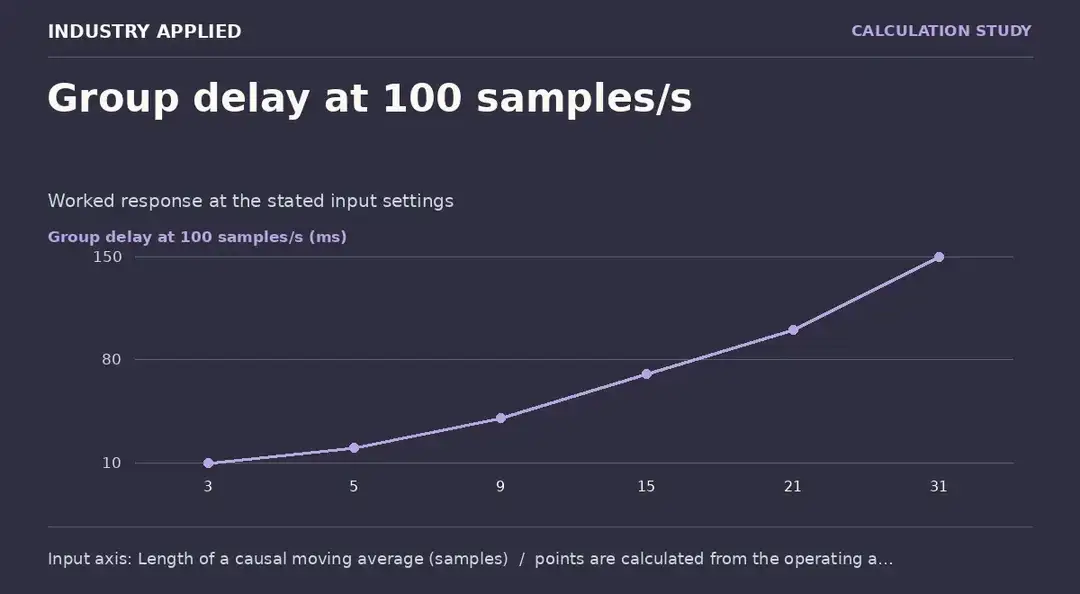
For a uniformly sampled moving-average filter, the linear-phase group delay is half the number of sample intervals in the window. In the worked example, Length of a causal moving average of 15 samples gives group delay at 100 samples/s of 70 ms.
Set up the field measurement
Timestamp the raw observation and filtered output separately when comparing a drive signal with a downstream flow response. Keep the reference observation alongside the calculation, with the instrument identification, observation period and units. This makes it possible for the next shift to distinguish a new operating condition from a change in how the observation was recorded.
Two operating points
At 9 samples the calculated group delay at 100 samples/s is 40 ms. At 15 samples it is 70 ms. Subtracting the first output from the second gives 30 ms. These values give two independent checkpoints for a spreadsheet or a logger conversion.
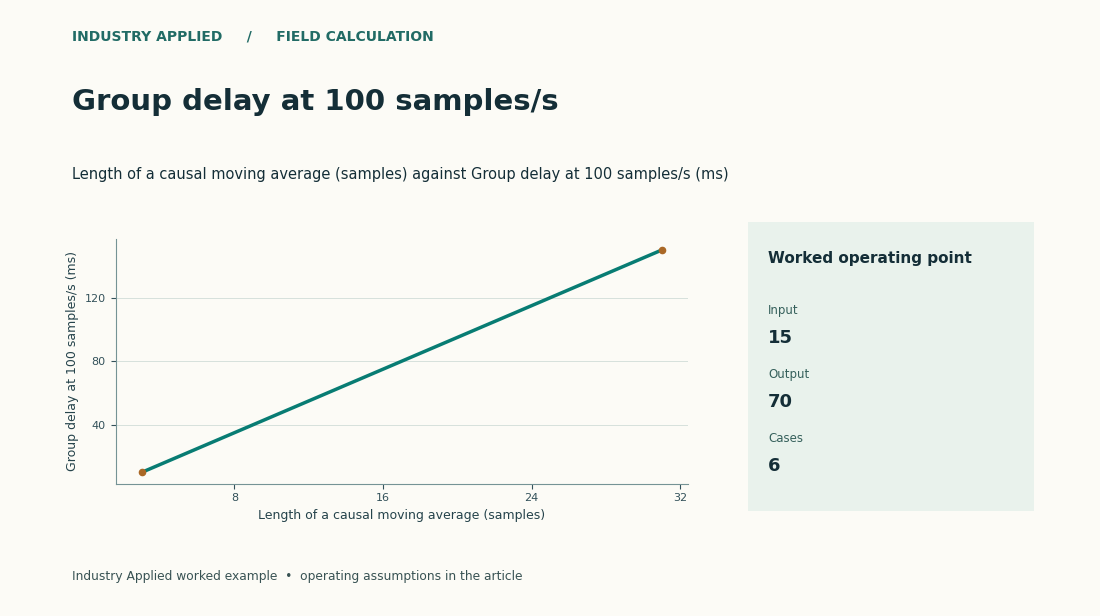
Worked data
Length of a causal moving average (samples) | Group delay at 100 samples/s (ms) |
|---|---|
3 | 10 |
5 | 20 |
9 | 40 |
15 | 70 |
21 | 100 |
31 | 150 |
Checking the working range
At the two ends of the example, an input of 3 gives 10 and an input of 31 gives 150. Use a value near each end to check your implementation. Testing only the middle row can conceal an incorrect offset, an inverted ratio or a unit conversion applied twice.
Interpreting the result
The first fully populated window takes longer than the group delay. Frequency attenuation and delay both matter when using the output for event timing. If measured performance sits outside the worked range, first repeat the comparison using field inputs and the same boundary. Preserve the original reading in the export. A discrepancy is easier to investigate when the field observation and the calculated output occupy separate columns.
Source and calculation data
For the underlying measurement context, see NI’s data-acquisition and signal-conditioning guide. The operating values and sensitivity analysis here are an Industry Applied worked example. Download the input and output values to verify the calculation with the values from your own site.