The saved swiCleInp.y signal is high at 20 of 101 checkpoints and changes state between adjacent checkpoints 2 times. The first recorded change is from 0 at 4 s to 1 at 4.1 s.
What the reference test measures
The Buildings model named Toggle comes from Lawrence Berkeley National Laboratory. The saved result covers simulation time 0 to 10 seconds. Industry Applied extracted 101 checkpoints for swiCleInp.y and kept the original signed values. The regular output spacing is 0.1 seconds. The solver may take different internal steps.
The model definition identifies swiCleInp (Toggle), falCleTruIni (Toggle), falCleFalIni (Toggle). These component names let a reader trace the plotted tags to their owning blocks before reproducing the result.
Settings to preserve when repeating the experiment
The published test declares cleInp.width = 0.5, cleInp.period = 6, togInp.width = 0.5. Those numbers use the units and component definitions in the linked model. Start with the declared configuration when reproducing the reference result, then vary one setting at a time. Changing the input waveform and the component response in the same comparison makes it difficult to identify the source of a difference.
Reading the two channels
At 0 seconds, swiCleInp.y is 0 and swiCleInp.u is 1. Subtracting the second channel from the first gives -1 encoded state, the largest absolute separation on their common saved grid. The channels have distinct roles in the model, so this difference describes the two traces and is not a calibrated instrument error.
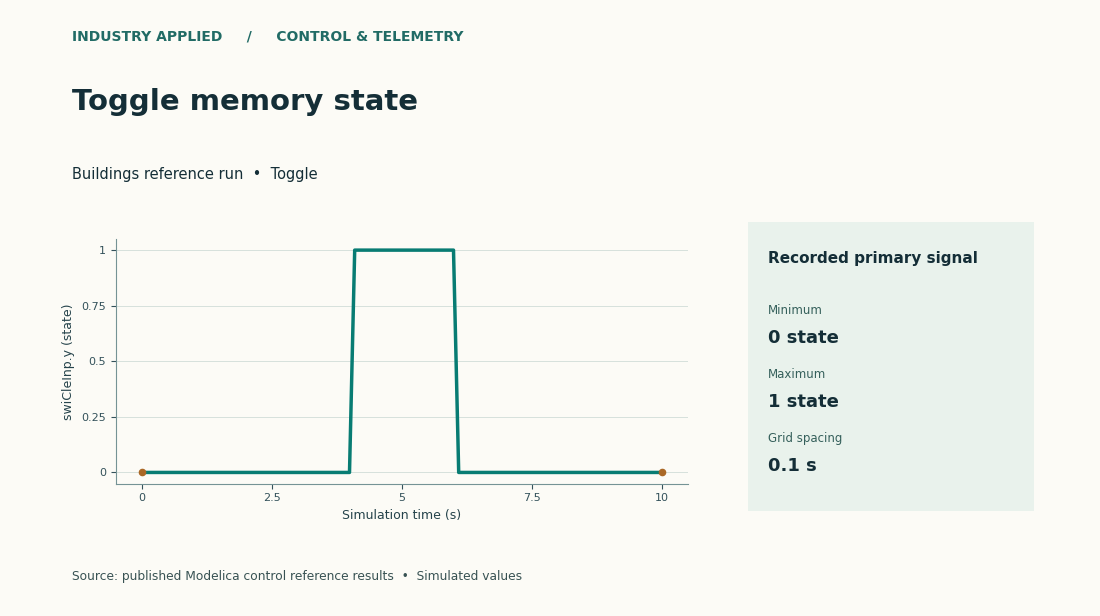
Reproducing the largest recorded change
Between the stored points at 4 and 4.1 seconds, swiCleInp.y changes from 0 to 1. Subtracting the earlier reading gives +1 encoded state. This interval contains the largest absolute point-to-point change in the saved primary channel. A faster excursion followed by recovery could fit entirely between the two records.
State changes are bracketed by saved output times. Counting high samples is not a pulse-width measurement. A brief transition between output points can be invisible in the saved Boolean trace.
Worked data
Simulation time (s) | swiCleInp.y (state) | swiCleInp.u (state) |
|---|---|---|
0 | 0 | 1 |
2.5 | 0 | 1 |
4 | 0 | 0 |
4.1 | 1 | 1 |
5 | 1 | 1 |
7.5 | 0 | 0 |
10 | 0 | 0 |
Applying the result to an operating site
A toggle remembers its previous state. A repeated event after reconnection can therefore reverse the intended result. Acceptance testing should include startup, duplicate events and the behaviour of the clear input.
For an Australian monitoring project, write the intended sample interval, timestamp convention, tag units and missed-update policy into the acceptance record. Re-run this comparison on the installed signal path and retain the raw export so a later dashboard change can be checked against the same baseline.
Model and data sources
Model definition. Original numerical reference series. Simulation and plotting script. Source project. Download the worked checkpoints as CSV.
Cover photograph by ed br, via Pexels. The photograph illustrates the subject. Industry Applied produced the figure and calculations from the linked source.