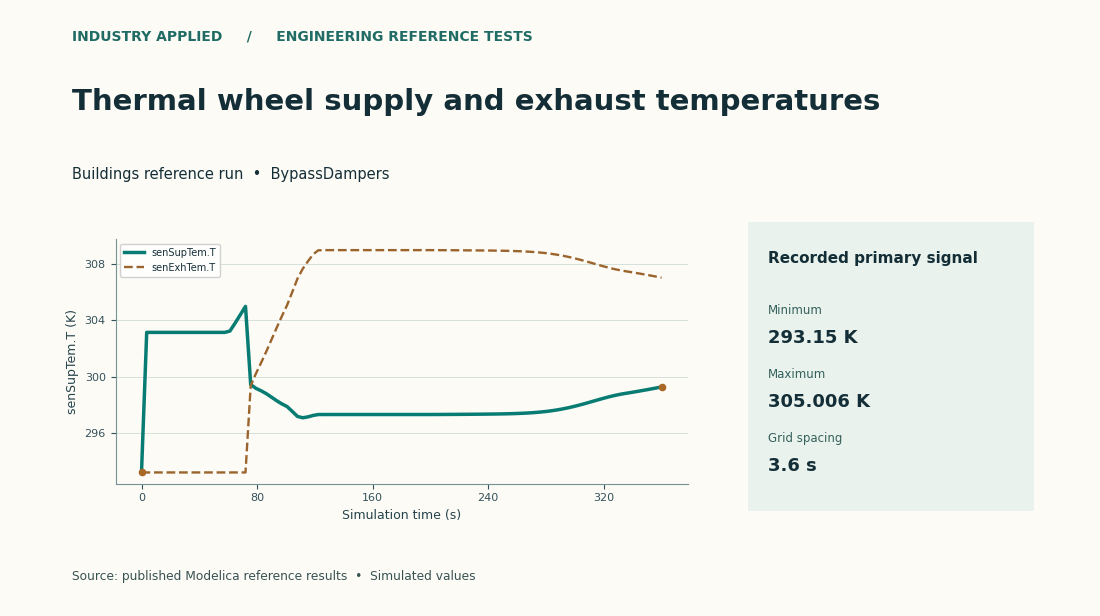
The thermal wheel supply and exhaust temperatures starts at 20 °C and finishes at 26.105 °C in this reference run. The model stores absolute temperature in kelvin. Its observed minimum and maximum convert to 20 °C and 31.856 °C.
What the reference test measures
The Buildings model named BypassDampers comes from Lawrence Berkeley National Laboratory. The saved result covers simulation time 0 to 360 seconds. Industry Applied extracted 101 checkpoints for senSupTem.T and kept the original signed values. The regular output spacing is 3.6 seconds. The solver may take different internal steps.
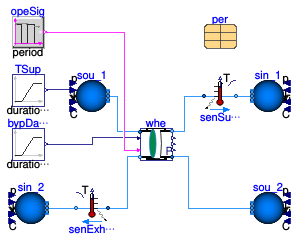
The model definition identifies senExhTem (Temperature Two Port), senSupTem (Temperature Two Port), sin_2 (Boundary p T). These component names let a reader trace the plotted tags to their owning blocks before reproducing the result.
Settings to preserve when repeating the experiment
The published test declares TSup.height = 10, TSup.duration = 60, TSup.startTime = 60. Those numbers use the units and component definitions in the linked model. Start with the declared configuration when reproducing the reference result, then vary one setting at a time. Changing the input waveform and the component response in the same comparison makes it difficult to identify the source of a difference.
Reading the two channels
At 72 seconds, senSupTem.T is 305.006 and senExhTem.T is 293.15. Subtracting the second channel from the first gives +11.856 K, the largest absolute separation on their common saved grid. The channels have distinct roles in the model, so this difference describes the two traces and is not a calibrated instrument error.
Reproducing the largest recorded change
Between the stored points at 0 and 3.6 seconds, senSupTem.T changes from 293.15 to 303.15. Subtracting the earlier reading gives +10 K. This interval contains the largest absolute point-to-point change in the saved primary channel. A faster excursion followed by recovery could fit entirely between the two records.
The extrema in the table and figure are extrema of the stored series. A solver’s internal peak, a field logger’s alarm value and a maximum derived from this export can differ. Preserve the sampling settings when comparing results.
Worked data
Simulation time (s) | senSupTem.T (K) | senExhTem.T (K) |
|---|---|---|
0 | 293.15 | 293.15 |
3.6 | 303.1505 | 293.15 |
72 | 305.0057 | 293.15 |
90 | 298.5247 | 302.634 |
180 | 297.2867 | 309.0242 |
270 | 297.4106 | 308.9006 |
360 | 299.2549 | 307.0594 |
Applying the result to an operating site
A thermal wheel transfers sensible energy and can also exchange moisture. Temperature alone cannot quantify its total recovered energy. Include humidity, airflow and bypass position on both sides before estimating a system saving.
For a local engineering comparison, write the measurement boundary, operating duty and instruments into the test record. Select comparable load or weather periods, then compare the measured trace with the simulated quantities. Establish a local acceptance tolerance using the intended duty and measurement uncertainty.
Model and data sources
Model definition. Original numerical reference series. Simulation and plotting script. Source project. Download the worked checkpoints as CSV.