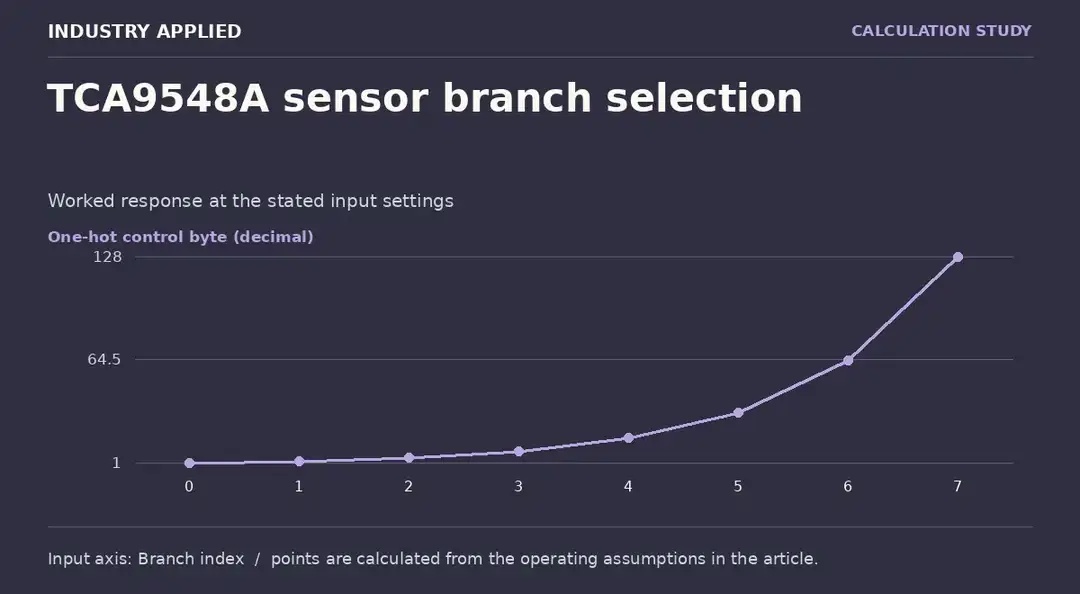
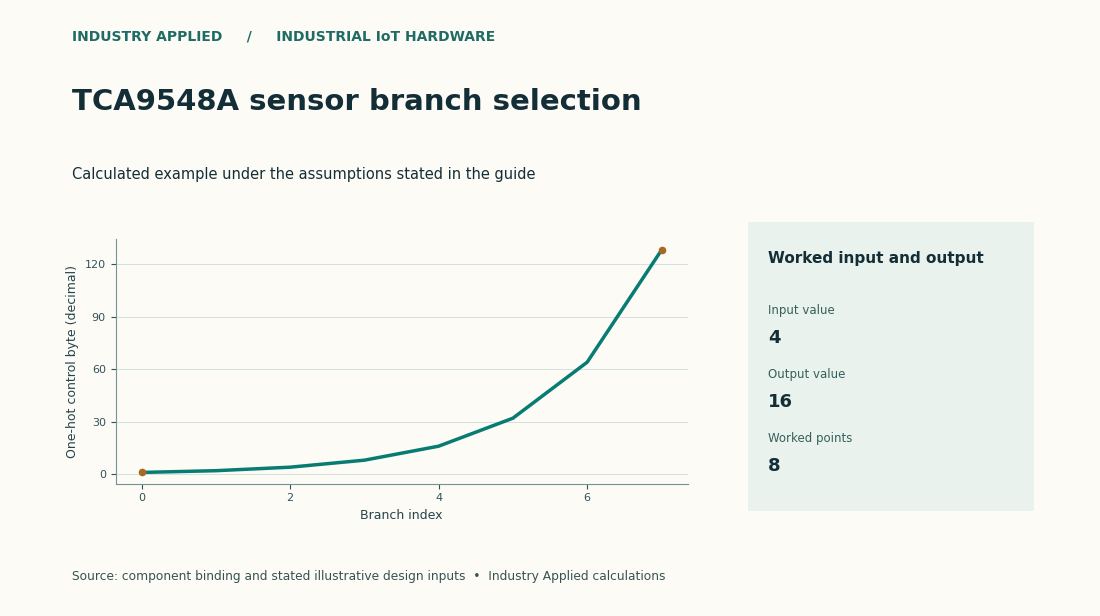
The eight branch indices run from zero to seven. In a one-branch selection, the mask is one shifted left by that index. The decimal values in the table correspond to one active bit in an eight-bit byte. With branch index at 4, the worked result is 16 on the one-hot control byte (decimal) scale.
The recorded quantity and the calculated result
Keep three columns in a commissioning export: the original branch index, the configuration used in the conversion and the resulting one-hot control byte (decimal). Recompute the result for the lower, middle and upper worked points before interpreting a field difference. A change in range, units or representation can otherwise be mistaken for a change in the process.
Two points to check independently
Take the neighbouring worked points 3 and 4 on the input axis. The results are 8 and 16, giving a signed difference of 8. The table preserves the calculated values before display rounding. These are calculated examples under the stated assumptions. They are not readings from a ProSense installation.
Worked data
Branch index | One-hot control byte (decimal) |
|---|---|
0 | 1 |
1 | 2 |
2 | 4 |
3 | 8 |
4 | 16 |
5 | 32 |
6 | 64 |
7 | 128 |
Checking the ends of the working range
The final interval in this example runs from 4 to 7 on the branch index axis. Its average change in one-hot control byte (decimal) per input unit is 37.333. This is a two-point slope for that interval. To check a spreadsheet or a gateway calculation, enter 7 in a separate test row and compare its result against 128 at the displayed precision.
Installation and interpretation
Two sensors with the same bus address can live on separate branches if only the intended branch is connected for that transaction. Keep branch and device address together in logs so that a perfectly valid sensor value is attributed to the right location.
For a repeatable verification, capture a small known case and a second case well away from it. Check whether the difference follows the response in the table, then restore the working configuration and repeat one reading. Store a separate status field for missing or invalid input. Substituting zero would make a dropped observation indistinguishable from a legitimate numerical zero.
Implementation and worked data
The source implementation is maintained in the .NET IoT device project. The component notes and manufacturer references document the supported device and its interfaces. Download the worked numerical example.