
Picture two fields served by one irrigation valve. One has deep loam. The other has a sandy rise that dries first. A single probe in the loam can give a good account of that patch while the rise is already short of water. Start with the irrigation decision the reading is meant to support.
Walk the irrigation block
On a map, mark the valve or bay boundaries, crop, main soil changes and areas that routinely run wet or dry. Choose a site in a soil and crop combination you actually manage. An untypical patch beside a gate, a leaky fitting or a wheel rut makes a poor reference for the rest of the field.
A known dry patch can deserve its own sensor. Label it as the dry zone and keep its trace separate from the typical zone. If both sites share one valve, the difference between them is information you can use when checking irrigation uniformity.
Choose depths you can explain
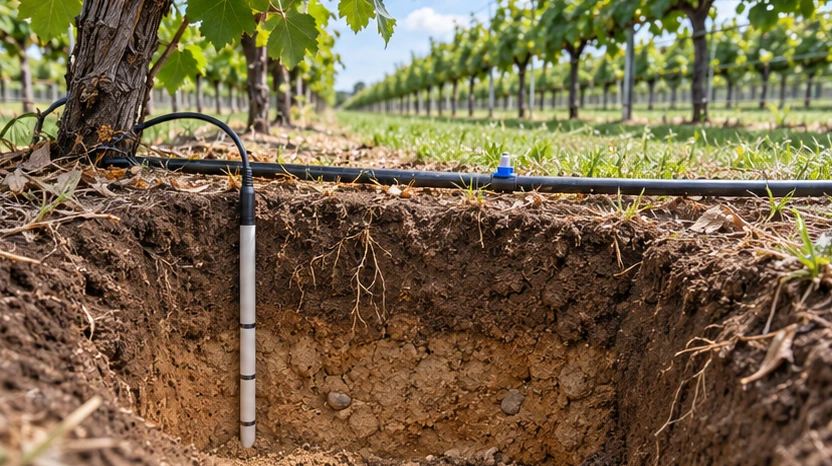
Check the crop’s effective root depth with a field observation. For an illustrative 60 cm root zone, sensors at around 20 cm and 40 cm sample the upper and lower parts of that zone. Record the actual sensing depths, soil texture and distance from the emitter. Revisit the choice as annual crops develop or if there is a compacted layer.
Read the first irrigation against the field
Record when irrigation starts and stops, any rainfall, and the readings immediately before the event. Look at which depth responds first and how long the change takes. Check soil near the measured depths and inspect the wetting pattern around the emitter. A flat lower trace could mean the wetting front stopped above it, the probe sits outside the wetted area, or the sensor has poor soil contact.
Repeat the check through another irrigation and drying cycle. A single irrigation trace is a starting observation. Set a refill point only after local soil behaviour, crop condition and the grower’s experience support it.
What to write on the site record
Block and irrigation zone, crop and growth stage, and why this patch was chosen.
Soil type, sensing depths, distance and direction from the emitter, and a photo of the location.
Irrigation and rain times, field observations, and the date of the next comparison.
Follow one irrigation through a vineyard row
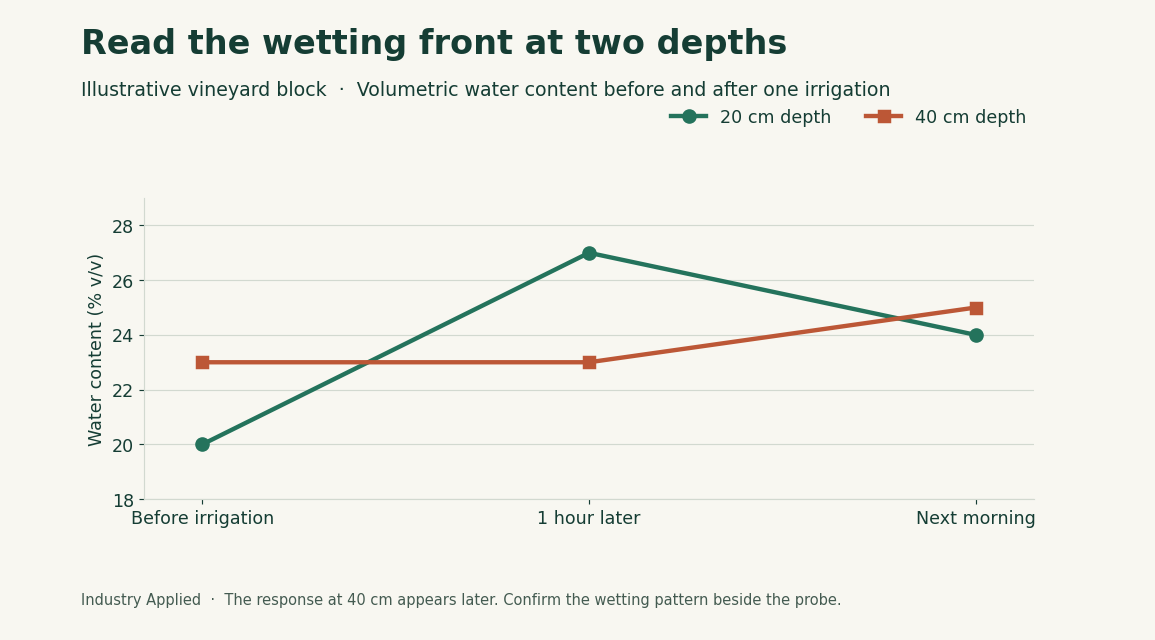
In an illustrative Australian vineyard, the sensor at 20 cm reads 20% volumetric water content just before irrigation, 27% one hour later and 24% the next morning. The 40 cm sensor reads 23%, 23% and 25% at those same times. The upper reading rose seven percentage points during the first interval. The lower reading first showed an increase the following morning. These snapshots bracket the observed change. They cannot tell you the exact instant the wetting front reached 40 cm.
Check the emitter, dig or core beside the instruments where appropriate, and compare soil at each sensing depth with the trace. If both depths near the emitter respond while a nearby dry rise remains dry, the graphs may be accurately describing two different watering patterns. Moving the probe until it gives a convenient number hides the evidence. Keep a representative reference site and identify the dry area separately.
Turn a point reading into a defensible decision
Suppose you wanted to convert the seven-point change into millimetres of water. If it represented a uniform 200 mm layer, the calculation would be 0.07 × 200 mm = 14 mm of storage change in that layer. A point sensor beside a dripper does not establish that the whole layer, or the whole row spacing, changed by that amount. Use the calculation to see what the assumption would mean. Check the wetted width and more than one location before treating it as a block water balance.
Give each installation a location photograph, emitter offset, actual sensing depths and a note about soil texture. Compare at least another wetting and drying cycle under a similar irrigation run. If growth stage, emitter spacing or the irrigated zone changes, add a dated note to the record so future operators can interpret a shift in the trace.
Sources
Agriculture Victoria (Australia) · Choosing the right soil moisture monitoring device
University of Minnesota Extension (United States) · Soil moisture sensors for irrigation scheduling
FAO · Deficit irrigation practices and observing the root zone