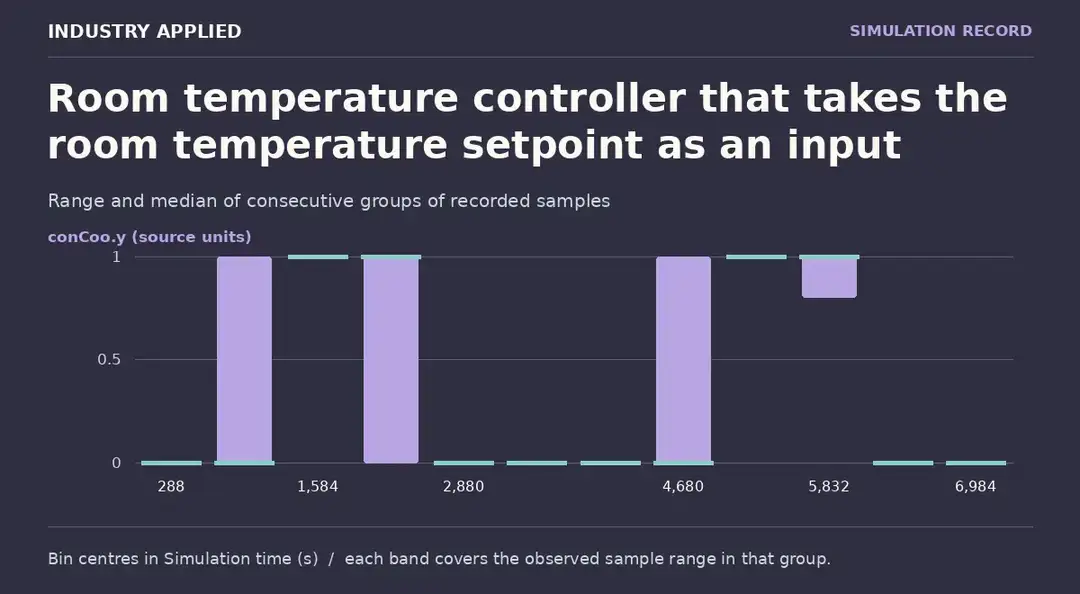
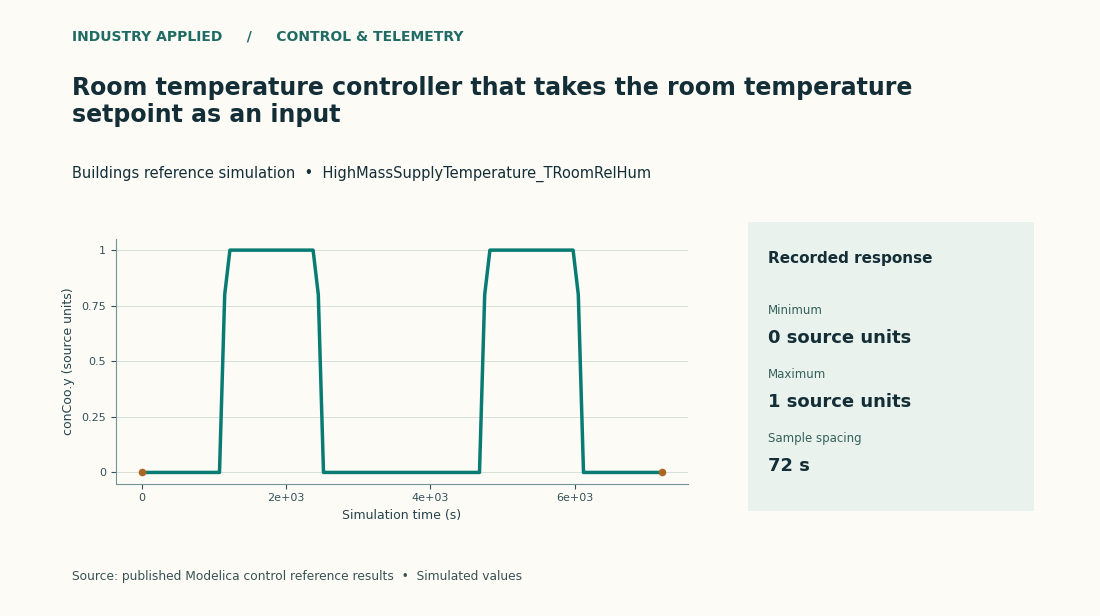
The conCoo.y trace ranges from 0 to 1 across 101 saved checkpoints. It begins at 0 and finishes at 0 after 7,200 s of test time. The source identifies the channel scale as dimensionless. Its first saved maximum occurs at 1,224 s.
The system being tested
Lawrence Berkeley National Laboratory publishes the Buildings test named HighMassSupplyTemperature_TRoomRelHum. The source file places it under Controls, OBC, Radiant Systems, Cooling. We used the 101 stored values for conCoo.y over the interval 0 to 7,200 seconds. This is a simulated test with specified inputs and boundaries.
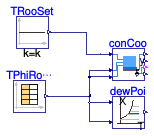
The component declarations name conCoo (High Mass Supply Temperature T Room Rel Hum), TRooSet (Constant), dewPoi (Dew Point T Dry Bul Phi). These identifiers can be found in the linked model definition. Check how they connect to the plotted quantity before comparing it with a field meter or a differently named controller tag.
Compare the recorded channels
At 1,152 s, conCoo.y is 0.8 and conCoo.yPum is 1. Subtracting the second value from the first gives -0.2. This is their largest recorded absolute separation. A difference between an inlet and an outlet, or between a command and a response, need not be a measurement error.
Reproduce the calculation
The largest absolute change between consecutive stored points appears from 1,080 to 1,152 seconds. Subtracting 0 from 0.8 gives 0.8 source units. Its location brackets the change within one saved interval of 72 seconds. It does not identify an unobserved instantaneous peak or the exact crossing time.
The worked table retains the first and last points, the primary maximum and minimum, the largest adjacent change and a spread of checkpoints across the run. Rounding is for presentation. Use the full linked reference series to repeat integrals or compare events between checkpoints. The archived sampling interval need not match the simulation solver’s internal step.
Worked data
Simulation time (s) | conCoo.y (dimensionless) | conCoo.yPum (dimensionless) |
|---|---|---|
0 | 0 | 0 |
1080 | 0 | 0 |
1152 | 0.8 | 1 |
1224 | 1 | 1 |
1440 | 1 | 1 |
2880 | 0 | 0 |
4320 | 0 | 0 |
5760 | 1 | 1 |
7200 | 0 | 0 |
What to check on site
Record each condition, calculated request and issued output as separate tags. Keep timestamps and the sample or event rule with the export. A stable displayed value may be held by logic after the measured input has changed.
State the operating duty, measurement location and expected tolerance before evaluating a local trend. Re-run the comparison with the installed controls and instruments during a representative operating period. Retain the native units and the raw export so that a later change in software or presentation can be investigated.
Units in the source model
The component declarations identify the scale of the exported variables. In this run, conCoo.y uses dimensionless and conCoo.yPum uses dimensionless. Keep the exact channel name and unit together when exporting data to a historian. Read the component definition.
Data and source model
Published model and component definitions. Numerical reference series. Simulation and plot commands. Download the worked checkpoints in CSV format.