
Agricultural Technology
The pivot end gun runs for 90 degrees. How many hectares does it add?
Use the area of an outer ring and the active angle. Counting the entire extension would quadruple the footprint in this example.
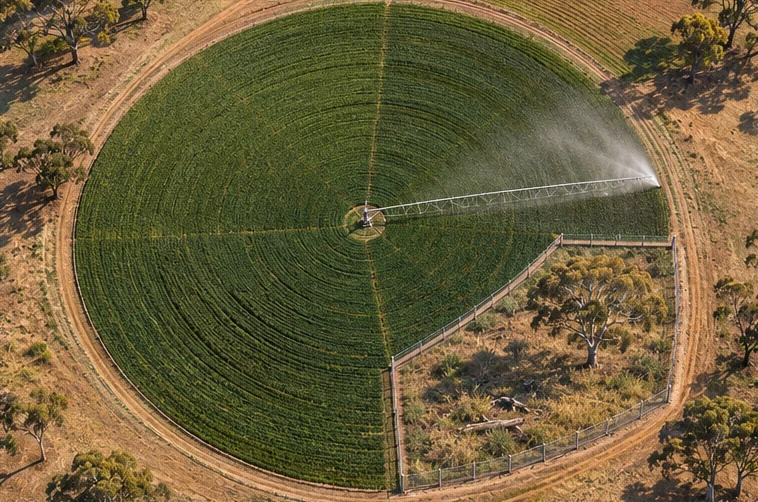
When an end gun operates for just part of a revolution, credit only the active sector of the outer ring. A full-circle base radius of 300 m irrigates about 28.27 ha. Extending the effective outer radius to 330 m adds 5.94 ha only if that extension waters the complete circle.
Subtract the two circles first
The outer ring covers π × (330² − 300²) square metres, or approximately 59,376 m². At a 90-degree active angle, take one quarter of the ring: about 14,844 m², or 1.48 ha. The total nominal footprint is then roughly 29.76 ha. Scaling the entire 330 m circle by one quarter would discard three quarters of the base pivot’s area.

Worked data
Active sector | Fraction of outer ring | Extra area (ha) |
0° | 0 | 0 |
90° | 0.25 | 1.48 |
180° | 0.50 | 2.97 |
360° | 1.00 | 5.94 |
Download the figures in this worked example (CSV)
Map the edge that actually receives useful water
The throw distance in a brochure is different from a measured effective wetted boundary. Wind, pressure and how the end gun is controlled can change the footprint. A controller may also have two separate active sectors. Add their non-overlapping angles and mark excluded roads, fences or unproductive corners.
For a farm budget, keep two maps: the nominal mechanical coverage for planning and the area shown to receive a useful depth in field observations. Using the larger figure for both can make application per hectare look lower than it is. A field check along the edges and at sector transitions is more informative than simply redrawing a perfect circle on an aerial photograph.
Sources
Victorian Resources Online · What shape can be irrigated?
NSW Department of Primary Industries · Evaluating a centre pivot irrigation system
Cover illustration by Industry Applied, generated with AI. A circular irrigated paddock with a partly watered outer sector.
Related reading
When an end gun operates for just part of a revolution, credit only the active sector of the outer ring. A full-circle base radius of 300 m irrigates about 28.27 ha. Extending the effective outer radius to 330 m adds 5.94 ha only if that extension waters the complete circle.
Subtract the two circles first
The outer ring covers π × (330² − 300²) square metres, or approximately 59,376 m². At a 90-degree active angle, take one quarter of the ring: about 14,844 m², or 1.48 ha. The total nominal footprint is then roughly 29.76 ha. Scaling the entire 330 m circle by one quarter would discard three quarters of the base pivot’s area.
Worked data
Active sector | Fraction of outer ring | Extra area (ha) |
0° | 0 | 0 |
90° | 0.25 | 1.48 |
180° | 0.50 | 2.97 |
360° | 1.00 | 5.94 |
Download the figures in this worked example (CSV)
Map the edge that actually receives useful water
The throw distance in a brochure is different from a measured effective wetted boundary. Wind, pressure and how the end gun is controlled can change the footprint. A controller may also have two separate active sectors. Add their non-overlapping angles and mark excluded roads, fences or unproductive corners.
For a farm budget, keep two maps: the nominal mechanical coverage for planning and the area shown to receive a useful depth in field observations. Using the larger figure for both can make application per hectare look lower than it is. A field check along the edges and at sector transitions is more informative than simply redrawing a perfect circle on an aerial photograph.
Sources
Victorian Resources Online · What shape can be irrigated?
NSW Department of Primary Industries · Evaluating a centre pivot irrigation system
Cover illustration by Industry Applied, generated with AI. A circular irrigated paddock with a partly watered outer sector.