
Agricultural Technology
The shed collected 9,000 litres. Why did the tank hold only 2,000 more?
Apply storage capacity at the time rain arrives. A daily balance can miss several kilolitres of overflow when draw-off happens later.
A roof can deliver more water in one storm than the tank can accept. Start with the free space just before the event. A 10 kL tank already holding 8 kL has only 2 kL available. If 9 kL reaches the inlet before any draw-off, 7 kL overflows, even if the business uses water later that day.
Follow a shed through the storm
An illustrative 500 m² roof receives 20 mm of rain. The gross rainfall volume is 10 kL because 1 mm over 1 m² equals 1 litre. Assume an event collection factor of 0.90 for this example. That gives 9 kL at the inlet. With the tank beginning at 8 kL, it reaches its 10 kL limit and spills 7 kL. A subsequent 3 kL draw-off leaves 7 kL in storage.

Worked data
Point in the day | Operation | Water in tank (kL) |
Before storm | Opening balance | 8 |
After rain | 9 kL arrives, 7 kL spills | 10 |
After use | 3 kL withdrawn | 7 |
Download the figures in this worked example (CSV)
What if the washing happened first?
Drawing 3 kL before the rain lowers the tank to 5 kL. Now 5 kL of the 9 kL inflow fits and 4 kL spills. The tank ends full. The same roof, rain, water use and nominal capacity produce two different closing balances. A model that merely subtracts total daily use from total daily rain cannot distinguish the outcomes.
The collection factor represents a stated assumption, not a universal roof coefficient. First-flush diversion, disconnected gutters and rain intensity can change it. For a sizing study, replay a local rainfall record with a plausible pattern of demand. Report overflow and unmet demand separately. This article concerns storage yield. Water quality, end use and system design require the site-specific guidance appropriate to the installation.
Compare tanks using water delivered, not rain captured by the roof
Suppose the farm is considering a 15 kL tank, with the same 8 kL opening inventory and the same storm-first sequence. The larger tank can accept 7 kL, spills 2 kL and holds 12 kL after the 3 kL draw. Compared with the 10 kL tank’s final 7 kL, it retains an additional 5 kL. That is the maximum immediate benefit under these assumptions. Its eventual benefit depends on whether the farm uses that extra water before another storm would have filled the smaller tank.
Now consider a different opening condition. If both tanks begin empty, both can accept the 9 kL event and both retain 6 kL after the 3 kL draw. The capacity upgrade delivers no extra stored water on that day. A business case using storm volume alone therefore overvalues capacity when the existing tank is usually empty and undervalues it when storm clusters regularly strike a nearly full tank.
A useful monitoring pair is inlet rainfall or a nearby gauge and a level record with a known tank volume curve. Add a draw-off meter or reliable use record if available. A level plateau at full capacity shows that an overflow opportunity existed. Its duration alone does not quantify overflow, because rainfall intensity and continuing draw-off can vary throughout the plateau.
Sources
enHealth · Guidance on the use of rainwater tanks
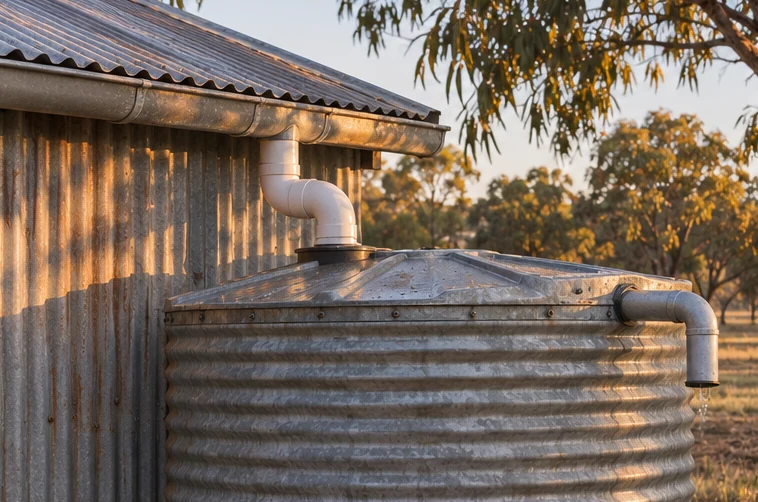
Cover illustration by Industry Applied, generated with AI. Farm shed roof and its rainwater collection tank.
A roof can deliver more water in one storm than the tank can accept. Start with the free space just before the event. A 10 kL tank already holding 8 kL has only 2 kL available. If 9 kL reaches the inlet before any draw-off, 7 kL overflows, even if the business uses water later that day.
Follow a shed through the storm
An illustrative 500 m² roof receives 20 mm of rain. The gross rainfall volume is 10 kL because 1 mm over 1 m² equals 1 litre. Assume an event collection factor of 0.90 for this example. That gives 9 kL at the inlet. With the tank beginning at 8 kL, it reaches its 10 kL limit and spills 7 kL. A subsequent 3 kL draw-off leaves 7 kL in storage.
Worked data
Point in the day | Operation | Water in tank (kL) |
Before storm | Opening balance | 8 |
After rain | 9 kL arrives, 7 kL spills | 10 |
After use | 3 kL withdrawn | 7 |
Download the figures in this worked example (CSV)
What if the washing happened first?
Drawing 3 kL before the rain lowers the tank to 5 kL. Now 5 kL of the 9 kL inflow fits and 4 kL spills. The tank ends full. The same roof, rain, water use and nominal capacity produce two different closing balances. A model that merely subtracts total daily use from total daily rain cannot distinguish the outcomes.
The collection factor represents a stated assumption, not a universal roof coefficient. First-flush diversion, disconnected gutters and rain intensity can change it. For a sizing study, replay a local rainfall record with a plausible pattern of demand. Report overflow and unmet demand separately. This article concerns storage yield. Water quality, end use and system design require the site-specific guidance appropriate to the installation.
Compare tanks using water delivered, not rain captured by the roof
Suppose the farm is considering a 15 kL tank, with the same 8 kL opening inventory and the same storm-first sequence. The larger tank can accept 7 kL, spills 2 kL and holds 12 kL after the 3 kL draw. Compared with the 10 kL tank’s final 7 kL, it retains an additional 5 kL. That is the maximum immediate benefit under these assumptions. Its eventual benefit depends on whether the farm uses that extra water before another storm would have filled the smaller tank.
Now consider a different opening condition. If both tanks begin empty, both can accept the 9 kL event and both retain 6 kL after the 3 kL draw. The capacity upgrade delivers no extra stored water on that day. A business case using storm volume alone therefore overvalues capacity when the existing tank is usually empty and undervalues it when storm clusters regularly strike a nearly full tank.
A useful monitoring pair is inlet rainfall or a nearby gauge and a level record with a known tank volume curve. Add a draw-off meter or reliable use record if available. A level plateau at full capacity shows that an overflow opportunity existed. Its duration alone does not quantify overflow, because rainfall intensity and continuing draw-off can vary throughout the plateau.
Sources
enHealth · Guidance on the use of rainwater tanks
Cover illustration by Industry Applied, generated with AI. Farm shed roof and its rainwater collection tank.