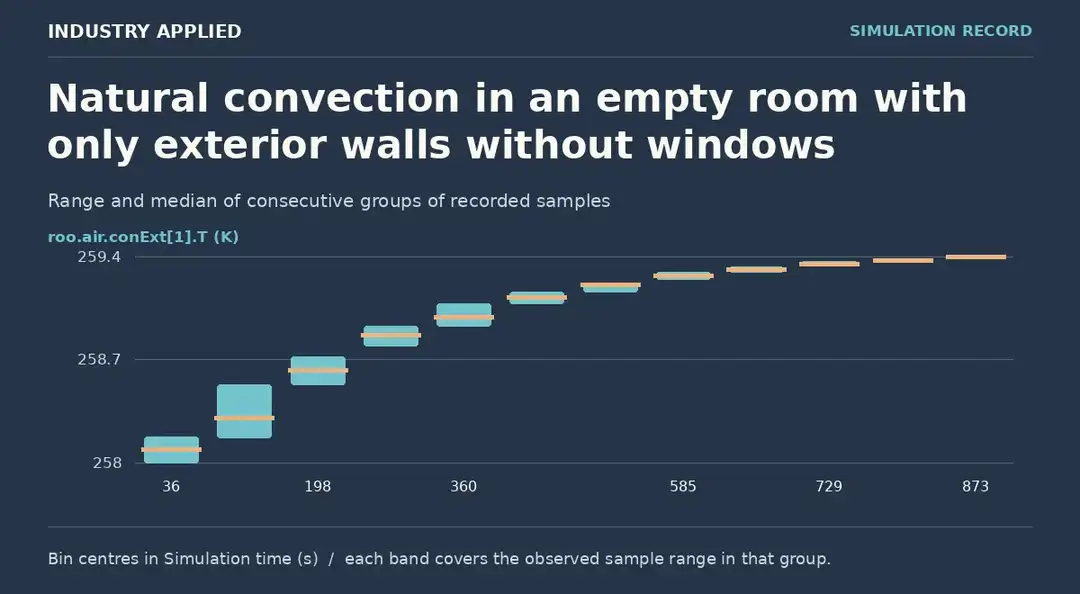
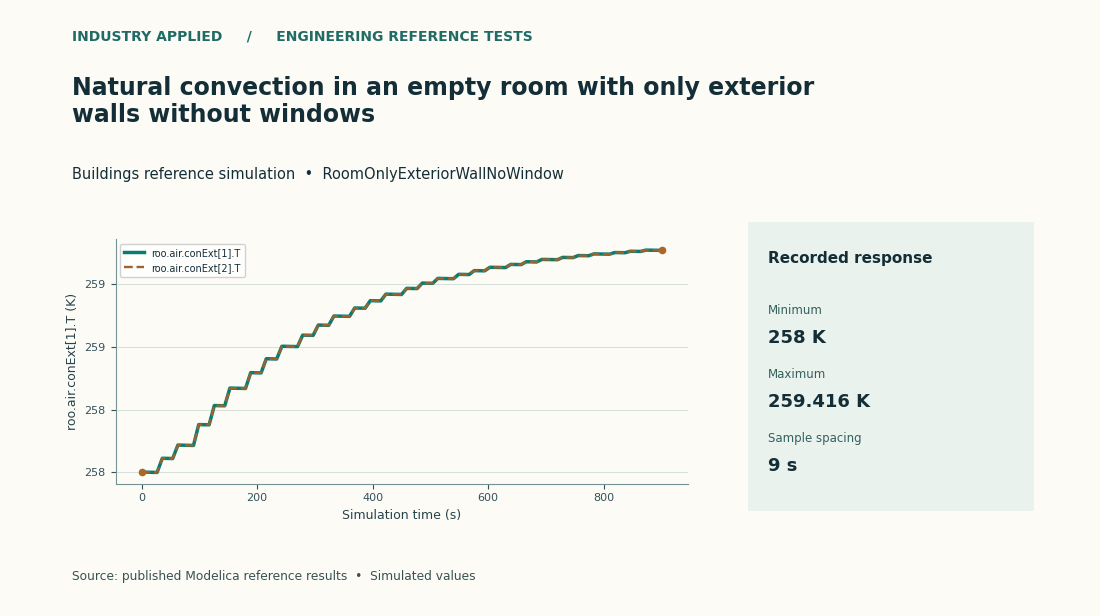
The recorded roo.air.conExt[1].T temperature spans -15.15 °C to -13.734 °C in this simulation. That is a change of 1.4165 K. The first saved maximum occurs at 873 s. The source trace and download retain absolute temperatures in kelvin.
The system being tested
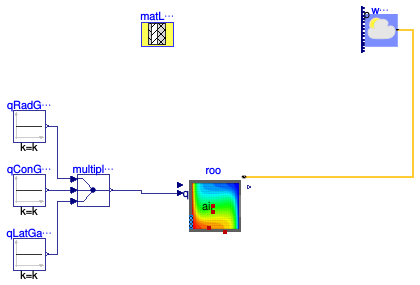
Lawrence Berkeley National Laboratory publishes the Buildings test named RoomOnlyExteriorWallNoWindow. The source file places it under Thermal Zones, Detailed, FFD. We used the 101 stored values for roo.air.conExt[1].T over the interval 0 to 900 seconds. This is a simulated test with specified inputs and boundaries.
The reference file contains 14 recorded variables. Alongside the primary output there are roo.yCFD[1], roo.yCFD[2], roo.air.conExt[1].Q_flow, roo.air.conExt[2].Q_flow, roo.air.conExt[3].Q_flow. The source and the export are linked independently below so that each reading can be traced back to its calculated channel.
Compare the recorded channels
At 585 s, roo.air.conExt[1].T is 259.285 K and roo.air.conExt[2].T is 259.285 K. Subtracting the second value from the first gives -6.104e-05 K. This is their largest recorded absolute separation. A difference between an inlet and an outlet, or between a command and a response, need not be a measurement error.
Reproduce the calculation
The largest absolute change between consecutive stored points appears from 90 to 99 seconds. Subtracting 258.172 from 258.305 gives 0.133 K. Its location brackets the change within one saved interval of 9 seconds. It does not identify an unobserved instantaneous peak or the exact crossing time.
The worked table retains the first and last points, the primary maximum and minimum, the largest adjacent change and a spread of checkpoints across the run. Rounding is for presentation. Use the full linked reference series to repeat integrals or compare events between checkpoints. The archived sampling interval need not match the simulation solver’s internal step.
Worked data
Simulation time (s) | roo.air.conExt[1].T (K) | roo.air.conExt[2].T (K) |
|---|---|---|
0 | 258.0022 | 258.0022 |
27 | 257.9998 | 257.9998 |
90 | 258.1717 | 258.1717 |
99 | 258.3047 | 258.3047 |
180 | 258.5349 | 258.5349 |
360 | 258.9943 | 258.9943 |
540 | 259.2341 | 259.2341 |
720 | 259.3553 | 259.3553 |
873 | 259.4163 | 259.4163 |
900 | 259.4146 | 259.4146 |
What to check on site
Keep the occupied schedule, weather boundary and zone definition with the result. A change in a simulated room condition can reflect the boundary assumptions as well as the component under study. Compare occupied periods and maintain the same observation location.
State the operating duty, measurement location and expected tolerance before evaluating a local trend. Re-run the comparison with the installed controls and instruments during a representative operating period. Retain the native units and the raw export so that a later change in software or presentation can be investigated.
Data and source model
Published model and component definitions. Numerical reference series. Simulation and plot commands. Download the worked checkpoints in CSV format.