
Industrial Automation
The motor drawing fewer amps can still use more real power
Two balanced three-phase motors at 400 V illustrate how power factor can reverse a ranking based on current alone.

A lower current reading is insufficient to rank two motors by electricity use. Under balanced sinusoidal three-phase conditions, real input power is √3 × line voltage × line current × power factor. A 20 A motor at power factor 0.90 can take more real power than a 22 A motor at 0.75, even when both are supplied at 400 V.
Compare the operating points
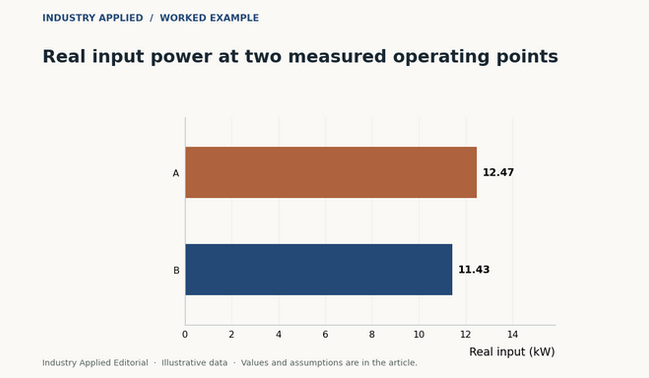
For the first motor the calculation gives about 12.47 kW. For the second it gives 11.43 kW. If both run for eight hours at those stable points, their input energies are approximately 99.8 and 91.5 kWh. A current-only ranking would put the second motor first on an energy investigation, even though it uses about 8.3 kWh less over that shift.
Worked data
Motor | Current and power factor | Real input (kW) |
A | 20 A at 0.90 | 12.47 |
B | 22 A at 0.75 | 11.43 |
Download the figures in this worked example (CSV)
What the numbers still cannot establish
The lower-input motor may also be delivering less shaft work. If one drives a partly closed valve and the other supplies the required flow at a different head, raw kWh is an incomplete comparison. Record hours and useful process duty, such as tonnes conveyed or volume delivered at the specified head.
Variable-speed drives and distorted waveforms require care with measured true power and the location of the meter. Use suitable existing metering or data gathered by qualified personnel. The US Department of Energy’s motor load guide explains the limitations of estimating load from current. For procurement, ask for efficiency at the duty points the plant actually uses, then compare actual electricity per unit of useful output.
Sources
US Department of Energy · Determining electric motor load and efficiency
Cover illustration by Industry Applied, generated with AI. Two electric motors in an industrial plant room.
A lower current reading is insufficient to rank two motors by electricity use. Under balanced sinusoidal three-phase conditions, real input power is √3 × line voltage × line current × power factor. A 20 A motor at power factor 0.90 can take more real power than a 22 A motor at 0.75, even when both are supplied at 400 V.
Compare the operating points
For the first motor the calculation gives about 12.47 kW. For the second it gives 11.43 kW. If both run for eight hours at those stable points, their input energies are approximately 99.8 and 91.5 kWh. A current-only ranking would put the second motor first on an energy investigation, even though it uses about 8.3 kWh less over that shift.
Worked data
Motor | Current and power factor | Real input (kW) |
A | 20 A at 0.90 | 12.47 |
B | 22 A at 0.75 | 11.43 |
Download the figures in this worked example (CSV)
What the numbers still cannot establish
The lower-input motor may also be delivering less shaft work. If one drives a partly closed valve and the other supplies the required flow at a different head, raw kWh is an incomplete comparison. Record hours and useful process duty, such as tonnes conveyed or volume delivered at the specified head.
Variable-speed drives and distorted waveforms require care with measured true power and the location of the meter. Use suitable existing metering or data gathered by qualified personnel. The US Department of Energy’s motor load guide explains the limitations of estimating load from current. For procurement, ask for efficiency at the duty points the plant actually uses, then compare actual electricity per unit of useful output.
Sources
US Department of Energy · Determining electric motor load and efficiency
Cover illustration by Industry Applied, generated with AI. Two electric motors in an industrial plant room.