
Industrial Automation
When can a shared calibration offset cancel between two probes?
A difference measurement can have a smaller or larger uncertainty than an independent-input calculation suggests. The covariance term explains when.
If two temperature readings include the same additive offset, subtracting the readings cancels that shared component. It does not cancel probe-specific drift, noise, unequal immersion or independent calibration terms. To estimate uncertainty in a temperature difference, identify shared and independent components before combining the numbers.
A worked uncertainty budget
Suppose each probe has a 0.20 °C standard uncertainty from the same reference offset with identical sensitivity and a separate 0.10 °C independent component. Subtract the first temperature from the second. The common term cancels exactly under this model. The resulting standard uncertainty is the square root of 0.10² + 0.10², or about 0.141 °C. If the supposedly shared 0.20 °C terms were actually independent, the result would be approximately 0.316 °C.

Worked data
Reference-offset relationship | Correlation coefficient | Standard uncertainty of difference (°C) |
Same offset | 1.0 | 0.141 |
Partly shared | 0.5 | 0.245 |
Independent offsets | 0.0 | 0.316 |
Download the figures in this worked example (CSV)
What makes the cancellation credible?
For y = T₂ − T₁, the variance includes minus twice the covariance. A common model number or calibration laboratory name does not establish covariance. Ask which reference, procedure, time period and component of the certificate the claim concerns. Calibration at different temperatures can also give different sensitivities to the same reference influences.
On a heat-exchanger trend in an Australian plant, the uncertainty of the temperature rise can matter more than the uncertainty of either absolute temperature. Preserve the absolute-temperature uncertainty when it is needed elsewhere. If the correlation is unknown, show plausible cases and explain which acceptance decision changes. NIST Technical Note 1297 gives the propagation relationship and the conditions behind the linear treatment.
What to ask for when the difference is the reported result
Write the measurement equation on the test sheet before listing certificate numbers. If a differential result is built from two independent instruments, record which input is subtracted, the temperature region over which it is used and which components are expressed as standard uncertainties. A reported expanded uncertainty must be interpreted with its stated coverage factor and model before it is combined as a standard term.
Now add a persistent 0.30 °C placement difference caused by one probe sitting in a poorly mixed pocket. Shared reference calibration does nothing to remove this effect. A pair of precisely calibrated probes can therefore give a very repeatable difference that is unrepresentative of the intended process temperatures. Site arrangement, time alignment and calibration all belong in the measurement equation if they materially affect the result.
A useful investigation is to compare measurements under a common reference condition using the approved method, then compare the installed pair in its actual application. Agreement at the reference helps distinguish instrument response from installation effects. It cannot prove both points of the installed process have the same temperature. Keep the raw observations, any correction and the uncertainty of that correction distinct.
Sources
NIST Technical Note 1297 · Law of propagation of uncertainty
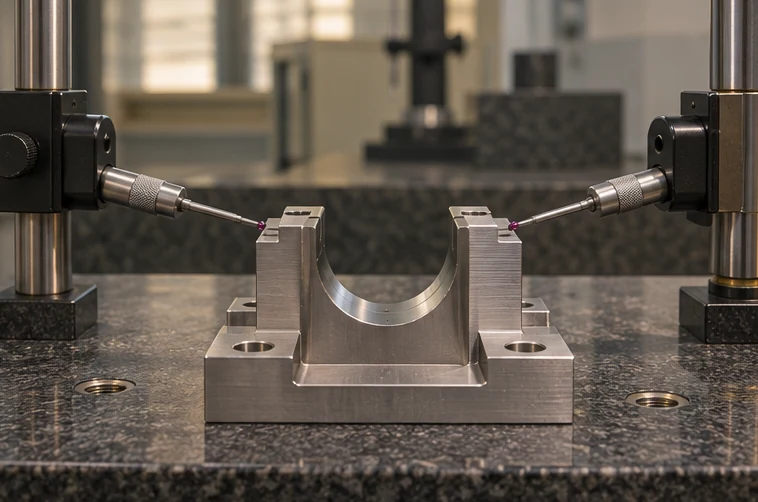
Cover illustration by Industry Applied, generated with AI. Matched measurement probes beside a machined fixture.
If two temperature readings include the same additive offset, subtracting the readings cancels that shared component. It does not cancel probe-specific drift, noise, unequal immersion or independent calibration terms. To estimate uncertainty in a temperature difference, identify shared and independent components before combining the numbers.
A worked uncertainty budget
Suppose each probe has a 0.20 °C standard uncertainty from the same reference offset with identical sensitivity and a separate 0.10 °C independent component. Subtract the first temperature from the second. The common term cancels exactly under this model. The resulting standard uncertainty is the square root of 0.10² + 0.10², or about 0.141 °C. If the supposedly shared 0.20 °C terms were actually independent, the result would be approximately 0.316 °C.
Worked data
Reference-offset relationship | Correlation coefficient | Standard uncertainty of difference (°C) |
Same offset | 1.0 | 0.141 |
Partly shared | 0.5 | 0.245 |
Independent offsets | 0.0 | 0.316 |
Download the figures in this worked example (CSV)
What makes the cancellation credible?
For y = T₂ − T₁, the variance includes minus twice the covariance. A common model number or calibration laboratory name does not establish covariance. Ask which reference, procedure, time period and component of the certificate the claim concerns. Calibration at different temperatures can also give different sensitivities to the same reference influences.
On a heat-exchanger trend in an Australian plant, the uncertainty of the temperature rise can matter more than the uncertainty of either absolute temperature. Preserve the absolute-temperature uncertainty when it is needed elsewhere. If the correlation is unknown, show plausible cases and explain which acceptance decision changes. NIST Technical Note 1297 gives the propagation relationship and the conditions behind the linear treatment.
What to ask for when the difference is the reported result
Write the measurement equation on the test sheet before listing certificate numbers. If a differential result is built from two independent instruments, record which input is subtracted, the temperature region over which it is used and which components are expressed as standard uncertainties. A reported expanded uncertainty must be interpreted with its stated coverage factor and model before it is combined as a standard term.
Now add a persistent 0.30 °C placement difference caused by one probe sitting in a poorly mixed pocket. Shared reference calibration does nothing to remove this effect. A pair of precisely calibrated probes can therefore give a very repeatable difference that is unrepresentative of the intended process temperatures. Site arrangement, time alignment and calibration all belong in the measurement equation if they materially affect the result.
A useful investigation is to compare measurements under a common reference condition using the approved method, then compare the installed pair in its actual application. Agreement at the reference helps distinguish instrument response from installation effects. It cannot prove both points of the installed process have the same temperature. Keep the raw observations, any correction and the uncertainty of that correction distinct.
Sources
NIST Technical Note 1297 · Law of propagation of uncertainty
Cover illustration by Industry Applied, generated with AI. Matched measurement probes beside a machined fixture.