
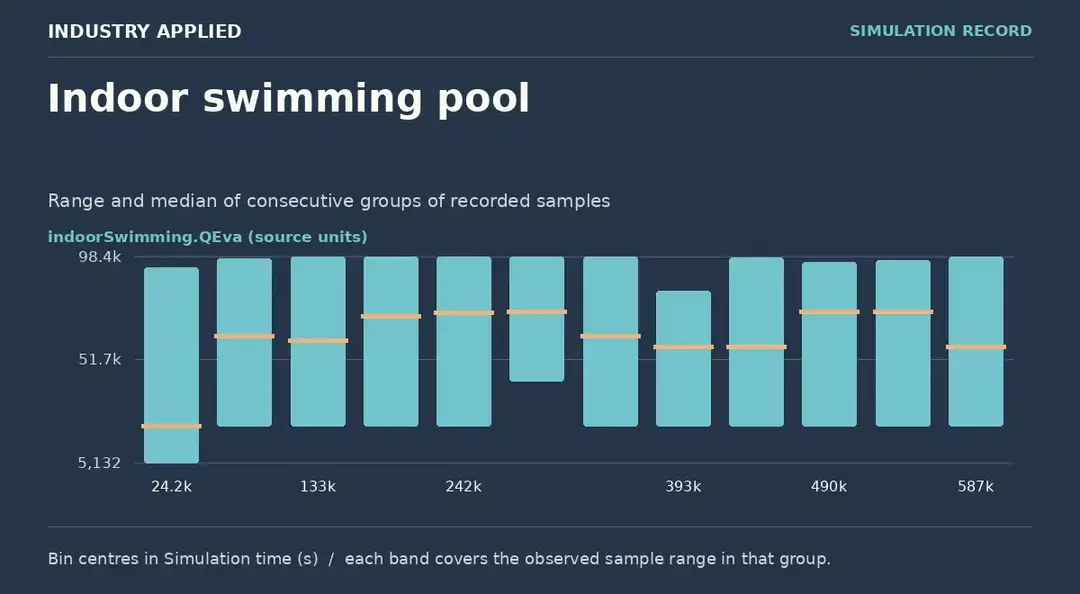
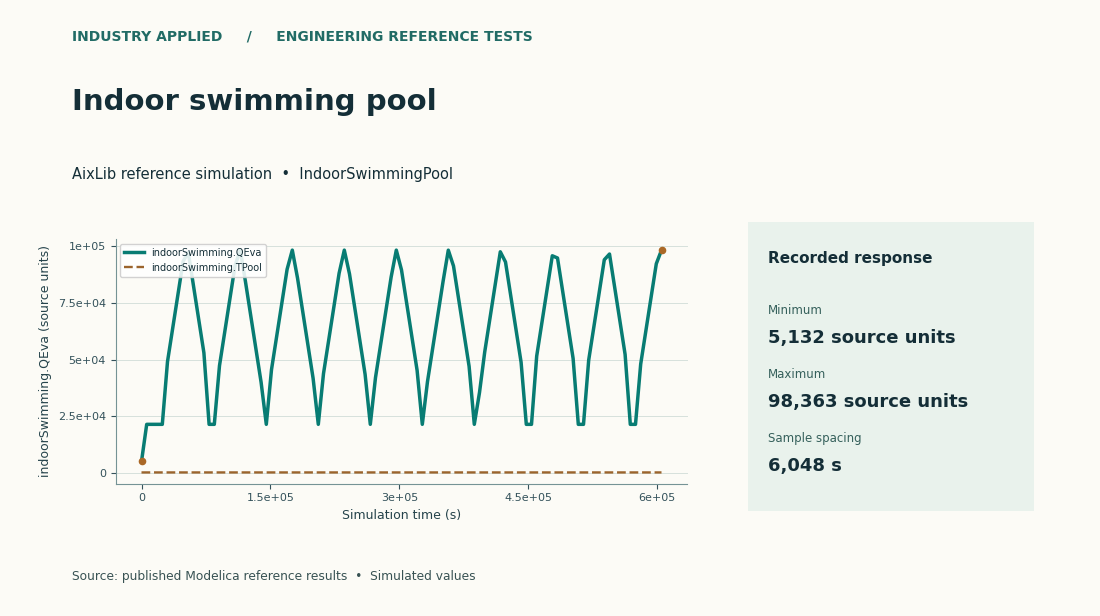
The recorded indoorSwimming.QEva channel spans 5,132 to 98,363 source units in this reference run. It starts at 5,132 and ends at 98,363. The first recorded maximum occurs at 114,912 seconds and the first minimum at 0 seconds.
The system being tested
The RWTH Aachen University E.ON Energy Research Center publishes the AixLib test named IndoorSwimmingPool. The source file places it under Fluid, Pools. We used the 101 stored values for indoorSwimming.QEva over the interval 0 to 604,800 seconds. This is a simulated test with specified inputs and boundaries.
The reference file contains 4 recorded variables. Alongside the primary output there are indoorSwimming.TPool, indoorSwimming.QPool, indoorSwimming.PPool, indoorSwimming.QEva. The source and the export are linked independently below so that each reading can be traced back to its calculated channel.
Compare the recorded channels
The two named channels have separate paths in the model. indoorSwimming.QEva begins at 5,131.9 and ends at 98,363. indoorSwimming.TPool begins at 295.33 and ends at 301.15. The reference export supplies numerical samples but does not attach a physical unit to these fields. Use the linked model declarations to establish the quantity and units of each channel before calculating a difference or assigning it a physical meaning.
Reproduce the calculation
The largest absolute change between consecutive stored points appears from 72,576 to 78,624 seconds. Subtracting 53,066 from 21,518 gives -31,548 source units. Its location brackets the change within one saved interval of 6,048 seconds. It does not identify an unobserved instantaneous peak or the exact crossing time.
The worked table retains the first and last points, the primary maximum and minimum, the largest adjacent change and a spread of checkpoints across the run. Rounding is for presentation. Use the full linked reference series to repeat integrals or compare events between checkpoints. The archived sampling interval need not match the simulation solver’s internal step.
Worked data
Simulation time (s) | indoorSwimming.QEva (source units) | indoorSwimming.TPool (source units) |
|---|---|---|
0 | 5131.888 | 295.3303 |
72576 | 53065.52 | 301.1525 |
78624 | 21517.62 | 301.1502 |
114912 | 98362.52 | 301.15 |
120960 | 84342.56 | 301.1525 |
241920 | 87856.82 | 301.1525 |
362880 | 91371.1 | 301.1525 |
483840 | 94885.37 | 301.1525 |
604800 | 98362.52 | 301.15 |
What to check on site
Identify which part of the system the selected output represents, and retain the surrounding boundary conditions. Compare the same event and operating duty in both records. Record the equipment configuration if a later change could alter the test result.
State the operating duty, measurement location and expected tolerance before evaluating a local trend. Re-run the comparison with the installed controls and instruments during a representative operating period. Retain the native units and the raw export so that a later change in software or presentation can be investigated.
Data and source model
Published model and component definitions. Numerical reference series. Simulation and plot commands. Download the worked checkpoints in CSV format.