
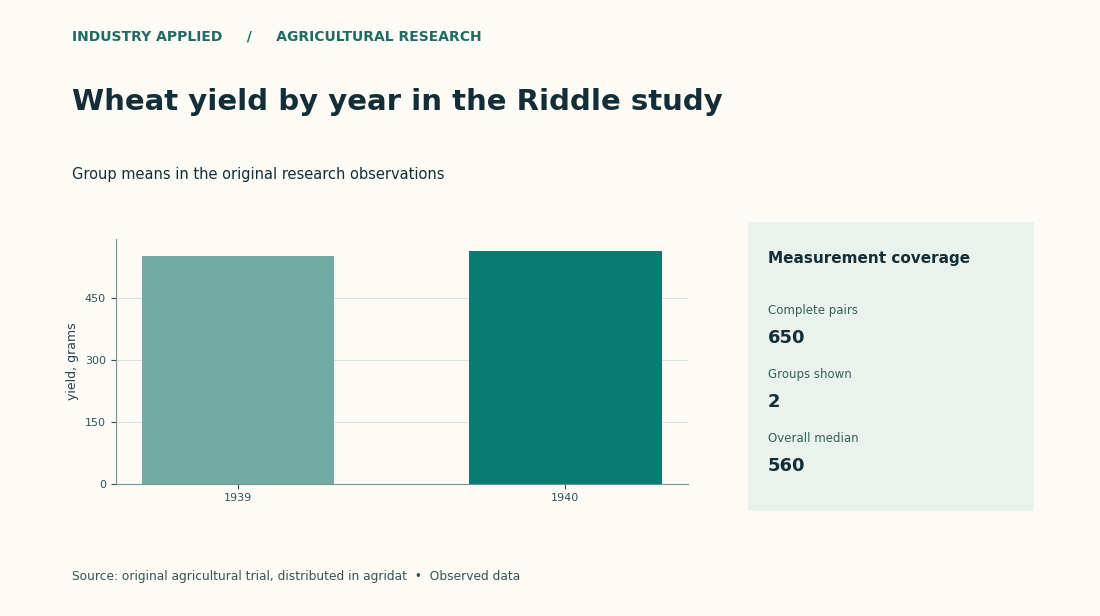
For 650 rows with both measurements available, the mean of yield was 551.2 in the year group “1939” and 564.89 in “1940”. The signed difference from the former to the latter is 13.69 in the original outcome units.
Reading the original field record
The source catalogues this experiment as “Modified Latin Square experiments of wheat”. The summary below addresses the yield comparison and uses the investigator’s recorded field names.
The original data dictionary describes the grouping or predictor field, year, as “year”. It describes the response, yield, as “yield, grams”. All numerical comparisons use the source scale. The complete table contains 650 rows, of which 0 were excluded for missing or unusable values in these two fields.
The table retains the 2 observed group labels. Each row in the original file contributes equal weight to its group mean. A second statistic, the median, helps show how much an unusually large or small measurement influences that mean.
What the measurements show
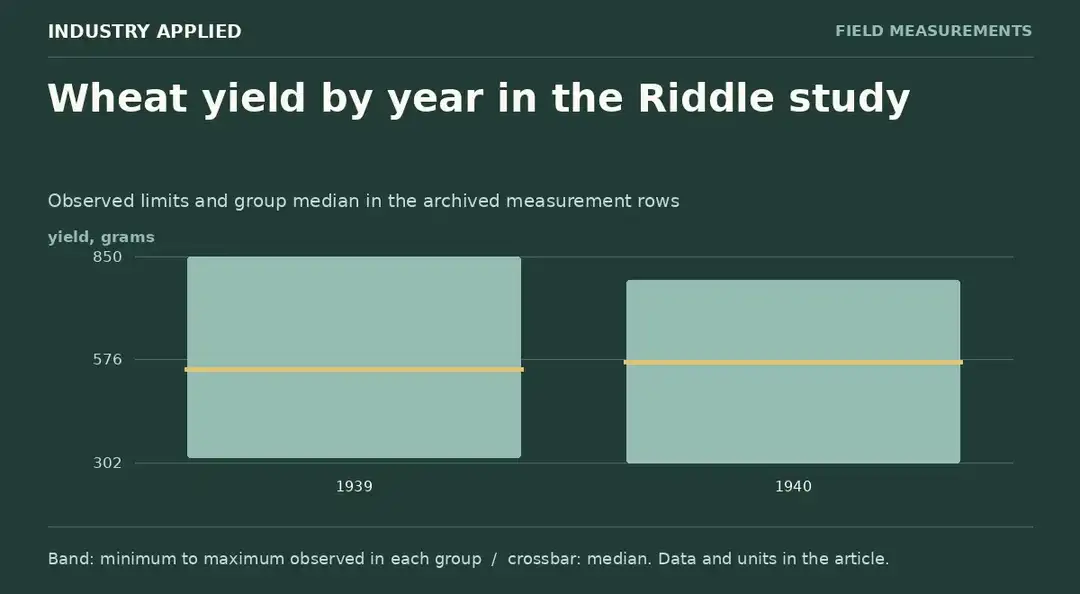
Group “1939” contains 325 observations, with a median of 550 and recorded limits of 315 and 850. Group “1940” contains 325, with a median of 568 and limits of 302 and 786. These groups are the ends of the recorded predictor range.
What changes when observations are matched?
Using rep (replicate) as the matching field gives 5 units represented at both “1939” and “1940”. Average repeated measurements inside each unit and group first. Then subtract the first group from the second for each unit. The median of those signed within-unit differences is 38.06. This calculation preserves one design dimension. Other treatments, seasons or field positions can still account for part of the difference.
Worked data
year group | Observations | Mean yield | Median yield | Minimum yield | Maximum yield |
|---|---|---|---|---|---|
1939 | 325 | 551.2 | 550 | 315 | 850 |
1940 | 325 | 564.8923 | 568 | 302 | 786 |
Taking the question back to the field
A blocked experiment groups units that share a common field condition. Retain block or check-entry identifiers if they occur in the design. Using the whole-field residual spread for every treatment misses the experiment’s assignment structure.
For a follow-up, keep the unit of observation with each record and decide before collection how a missing reading will be handled. Retain a reference treatment or measurement, the sampling dates and the original field layout. The GRDC paddock trial design guide describes replication and the planning of comparisons under farm conditions.
Data and original research
The study is credited to Riddle, O. C., G. A. Baker (1944). Kevin Wright’s agridat study record and original source credits document the experimental data. Original publication. Underlying observation file. Download the chart calculations.