
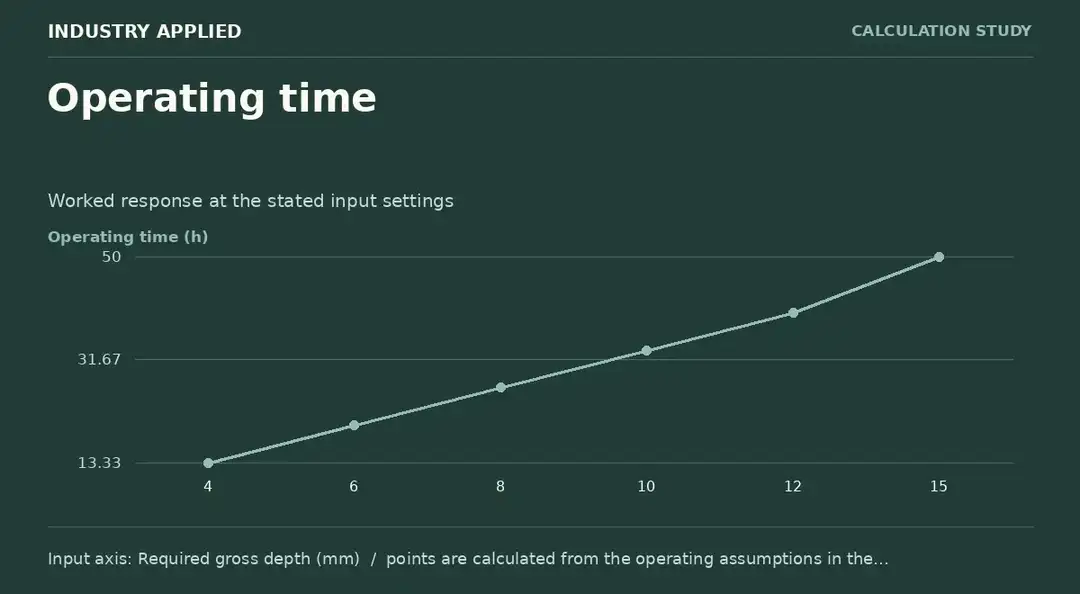
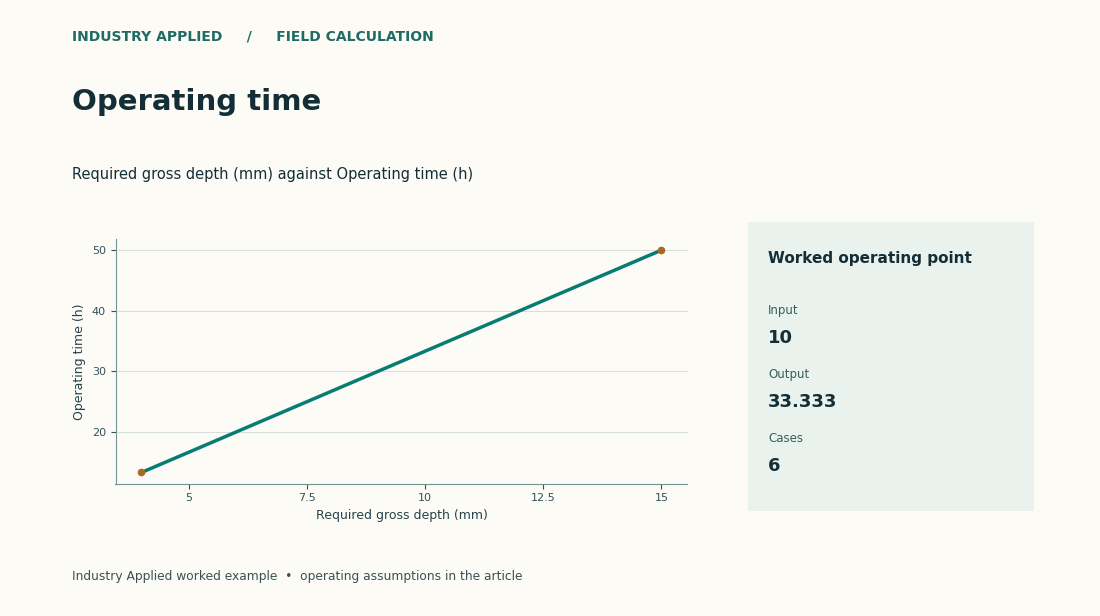
Each millimetre on a 40 ha circle requires 400 cubic metres. Divide volume by 120 cubic metres per hour. In the worked example, Required gross depth of 10 mm gives operating time of 33.333 h.
Set up the field measurement
Keep the measured machine flow, irrigated area and depth on the same set. Check the end-gun status when determining the actual area. Keep the reference observation alongside the calculation, with the instrument identification, observation period and units. This makes it possible for the next shift to distinguish a new operating condition from a change in how the observation was recorded.
Two operating points
At 8 mm the calculated operating time is 26.667 h. At 10 mm it is 33.333 h. Subtracting the first output from the second gives 6.6667 h. These values give two independent checkpoints for a spreadsheet or a logger conversion.
Worked data
Required gross depth (mm) | Operating time (h) |
|---|---|
4 | 13.33333 |
6 | 20 |
8 | 26.66667 |
10 | 33.33333 |
12 | 40 |
15 | 50 |
Checking the working range
At the two ends of the example, an input of 4 gives 13.333 and an input of 15 gives 50. Use a value near each end to check your implementation. Testing only the middle row can conceal an incorrect offset, an inverted ratio or a unit conversion applied twice.
Interpreting the result
This is total operating time. Wheel travel, sector exclusion and day-to-day stoppages can make the clock time longer. If measured performance sits outside the worked range, first repeat the comparison using field inputs and the same boundary. Preserve the original reading in the export. A discrepancy is easier to investigate when the field observation and the calculated output occupy separate columns.
Source and calculation data
For the underlying measurement context, see FAO’s technical handbook on pressurised irrigation. The operating values and sensitivity analysis here are an Industry Applied worked example. Download the input and output values to verify the calculation with the values from your own site.