
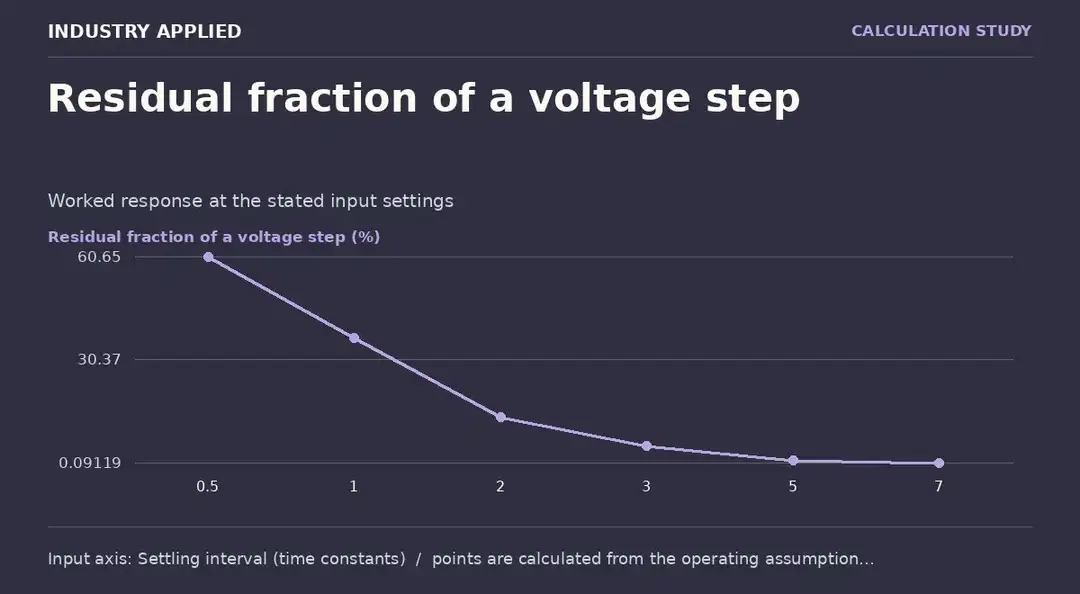
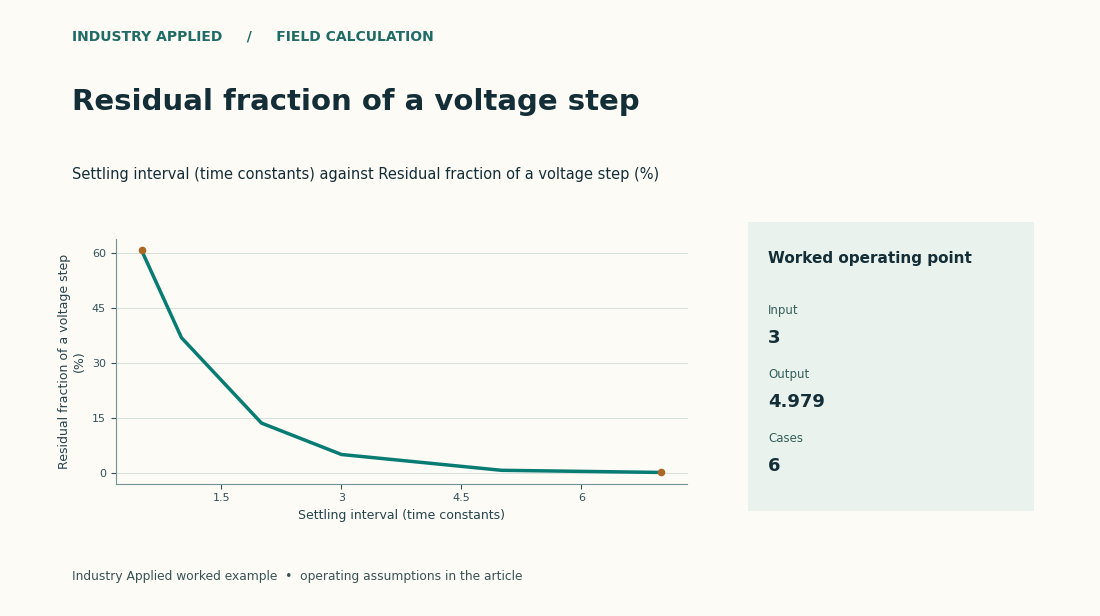
For a first-order response, multiply the initial step by the exponential of minus elapsed time divided by the time constant. In the worked example, Settling interval of 3 time constants gives residual fraction of a voltage step of 4.9787 %.
Set up the field measurement
Test a low and high channel consecutively. Repeat in reverse order to reveal incomplete settling that masquerades as cross-channel variation. Keep the reference observation alongside the calculation, with the instrument identification, observation period and units. This makes it possible for the next shift to distinguish a new operating condition from a change in how the observation was recorded.
Two operating points
At 2 time constants the calculated residual fraction of a voltage step is 13.534 %. At 3 time constants it is 4.9787 %. Subtracting the first output from the second gives -8.5548 %. These values give two independent checkpoints for a spreadsheet or a logger conversion.
Worked data
Settling interval (time constants) | Residual fraction of a voltage step (%) |
|---|---|
0.5 | 60.65307 |
1 | 36.78794 |
2 | 13.53353 |
3 | 4.978707 |
5 | 0.6737947 |
7 | 0.0911882 |
Checking the working range
At the two ends of the example, an input of 0.5 gives 60.653 and an input of 7 gives 0.09119. Use a value near each end to check your implementation. Testing only the middle row can conceal an incorrect offset, an inverted ratio or a unit conversion applied twice.
Interpreting the result
A real multiplexer can exhibit additional charge injection and multi-pole behaviour. Establish the delay against measured accuracy requirements. If measured performance sits outside the worked range, first repeat the comparison using field inputs and the same boundary. Preserve the original reading in the export. A discrepancy is easier to investigate when the field observation and the calculated output occupy separate columns.
Source and calculation data
For the underlying measurement context, see NI’s data-acquisition and signal-conditioning guide. The operating values and sensitivity analysis here are an Industry Applied worked example. Download the input and output values to verify the calculation with the values from your own site.