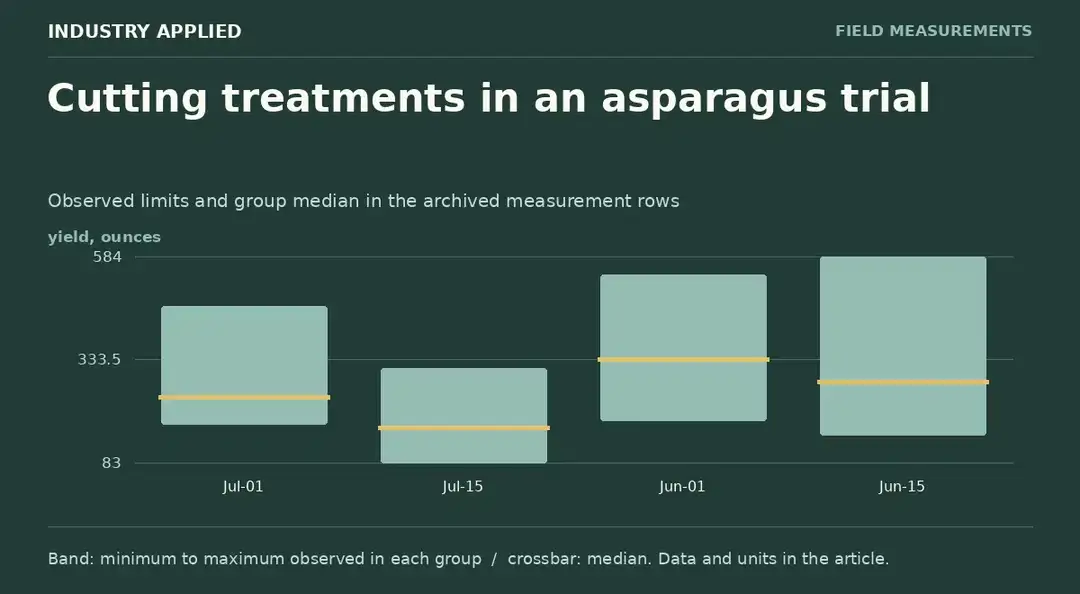
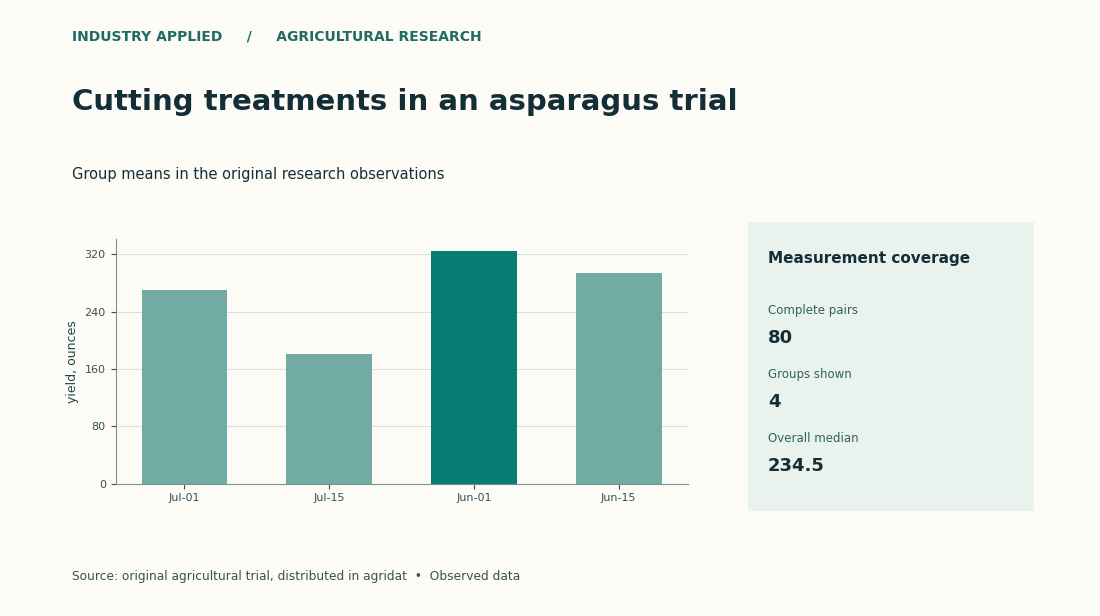
For 80 rows with both measurements available, the mean of yield was 181.2 in the trt group “Jul-15” and 325.05 in “Jun-01”. The signed difference from the former to the latter is 143.85 in the original outcome units.
Reading the original field record
The original data dictionary describes the grouping or predictor field, trt, as “treatment factor of final cutting date”. It describes the response, yield, as “yield, ounces”. All numerical comparisons use the source scale. The complete table contains 80 rows, of which 0 were excluded for missing or unusable values in these two fields.
The table retains the 4 observed group labels. Each row in the original file contributes equal weight to its group mean. A second statistic, the median, helps show how much an unusually large or small measurement influences that mean.
What the measurements show
Group “Jul-15” contains 20 observations, with a median of 168 and recorded limits of 83 and 312. Group “Jun-01” contains 20, with a median of 334 and limits of 185 and 540. These groups have the lowest and highest observed means across the displayed categories.
What changes when observations are matched?
Using block (block factor, 4 levels) as the matching field gives 4 units represented at both “Jul-15” and “Jun-01”. Average repeated measurements inside each unit and group first. Then subtract the first group from the second for each unit. The median of those signed within-unit differences is 137.8. This calculation preserves one design dimension. Other treatments, seasons or field positions can still account for part of the difference.
Worked data
trt group | Observations | Mean yield | Median yield | Minimum yield | Maximum yield |
|---|---|---|---|---|---|
Jul-01 | 20 | 270.4 | 241.5 | 177 | 462 |
Jul-15 | 20 | 181.2 | 168 | 83 | 312 |
Jun-01 | 20 | 325.05 | 334 | 185 | 540 |
Jun-15 | 20 | 293.45 | 278.5 | 150 | 584 |
Taking the question back to the field
An asparagus cutting treatment may affect later production as well as the current harvest. Retain year, block and treatment history when comparing cumulative outcomes. The marketability of the harvested spears is a separate consideration.
For a follow-up, keep the unit of observation with each record and decide before collection how a missing reading will be handled. Retain a reference treatment or measurement, the sampling dates and the original field layout. The GRDC paddock trial design guide describes replication and the planning of comparisons under farm conditions.
Data and original research
The study is credited to Snedecor, Cochran (1989). Kevin Wright’s agridat study record and original source credits document the experimental data. Underlying observation file. Download the chart calculations.