
Industrial Automation
How much air did a receiver supply during a short production surge?
Estimate free-air delivery from a recorded pressure dip while accounting for receiver volume, duration and the compressor that kept running.
A receiver’s pressure dip can reveal the shortfall between compressor supply and plant demand. It does not directly reveal the total demand. In an illustrative near-isothermal event, a 2 m³ receiver losing 0.6 bar contains about 1.2 m³ less air expressed at a reference pressure of 1 bar absolute. If the dip took 12 seconds, the receiver supplied the equivalent of 6 m³/min over that interval.
Balance the shortfall and the running supply
The simple fixed-volume model uses receiver volume × pressure change ÷ reference absolute pressure. Gauge pressure readings can be subtracted to obtain the change if they share the same atmospheric reference. The pressure used as the divisor must be absolute. Retain the reference temperature and pressure when comparing the result with a compressor’s free-air rating.

Worked data
Dip duration (s) | Free-air equivalent released (m³) | Mean shortfall (m³/min) |
6 | 1.2 | 12 |
12 | 1.2 | 6 |
24 | 1.2 | 3 |
Download the figures in this worked example (CSV)
Test the production explanation
If the compressor continued delivering 8 m³/min on the same reference basis during the 12-second event, the combined demand estimate is about 14 m³/min. If it unloaded half-way through, that addition changes. The compressor-state record and flow trend often matter more than another decimal place on the pressure gauge.
Use records from normal operation and mark where the pressure transmitter sits. Connected pipe volume, pressure loss between receiver and sensor, temperature change and logging speed can all move the estimate. A 15-second logging interval cannot resolve the shape of a 12-second dip. The US Department of Energy sourcebook treats storage and transient demand as parts of the same system. This calculation interprets recorded trends. Receiver sizing or pressure-setting changes require the actual system design.
Distinguish a storage restriction from a supply shortage
A receiver-mounted pressure trace and a trace near the packaging machine answer different questions. If the vessel holds its pressure while the machine-side reading dips, the short event can be dominated by the distribution path. A receiver pressure dip followed by a delayed recovery is a different observation. Compare clocks and logging intervals before trying to sequence the two traces.
The estimated 1.2 cubic metres is a reference-volume equivalent, not the geometric amount of empty space left in the vessel. The physical vessel remained 2 cubic metres throughout the event. The model expresses the change in contained mass as the volume that the missing air would occupy at the chosen reference state. This distinction matters when a vendor quotes normal cubic metres and an existing flowmeter reports actual volume at line pressure.
A useful sensitivity check is to repeat the calculation using the lowest and highest credible pressure change. With a 0.5–0.7 bar change instead of exactly 0.6 bar, the inferred shortfall over 12 seconds runs from 5 to 7 m³/min. If a decision turns on a fraction of a cubic metre per minute, the pressure record and connected storage volume need more scrutiny before procurement.
Sources
US Department of Energy · Compressed air system performance and storage
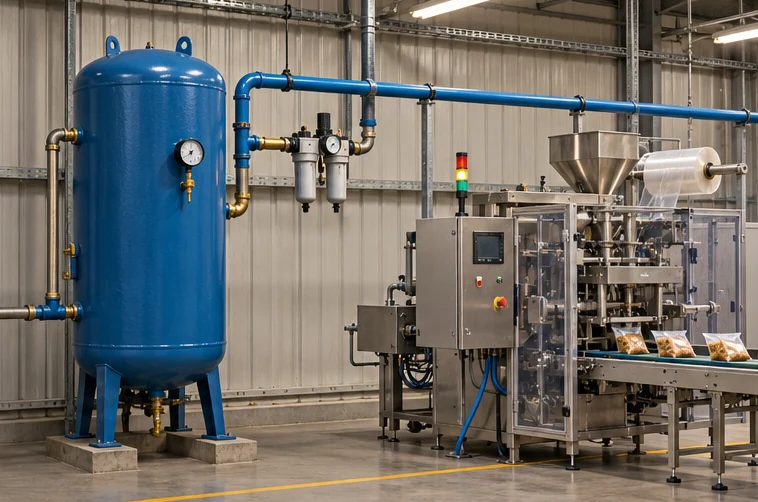
Cover illustration by Industry Applied, generated with AI. An air receiver beside a factory compressed-air header.
A receiver’s pressure dip can reveal the shortfall between compressor supply and plant demand. It does not directly reveal the total demand. In an illustrative near-isothermal event, a 2 m³ receiver losing 0.6 bar contains about 1.2 m³ less air expressed at a reference pressure of 1 bar absolute. If the dip took 12 seconds, the receiver supplied the equivalent of 6 m³/min over that interval.
Balance the shortfall and the running supply
The simple fixed-volume model uses receiver volume × pressure change ÷ reference absolute pressure. Gauge pressure readings can be subtracted to obtain the change if they share the same atmospheric reference. The pressure used as the divisor must be absolute. Retain the reference temperature and pressure when comparing the result with a compressor’s free-air rating.
Worked data
Dip duration (s) | Free-air equivalent released (m³) | Mean shortfall (m³/min) |
6 | 1.2 | 12 |
12 | 1.2 | 6 |
24 | 1.2 | 3 |
Download the figures in this worked example (CSV)
Test the production explanation
If the compressor continued delivering 8 m³/min on the same reference basis during the 12-second event, the combined demand estimate is about 14 m³/min. If it unloaded half-way through, that addition changes. The compressor-state record and flow trend often matter more than another decimal place on the pressure gauge.
Use records from normal operation and mark where the pressure transmitter sits. Connected pipe volume, pressure loss between receiver and sensor, temperature change and logging speed can all move the estimate. A 15-second logging interval cannot resolve the shape of a 12-second dip. The US Department of Energy sourcebook treats storage and transient demand as parts of the same system. This calculation interprets recorded trends. Receiver sizing or pressure-setting changes require the actual system design.
Distinguish a storage restriction from a supply shortage
A receiver-mounted pressure trace and a trace near the packaging machine answer different questions. If the vessel holds its pressure while the machine-side reading dips, the short event can be dominated by the distribution path. A receiver pressure dip followed by a delayed recovery is a different observation. Compare clocks and logging intervals before trying to sequence the two traces.
The estimated 1.2 cubic metres is a reference-volume equivalent, not the geometric amount of empty space left in the vessel. The physical vessel remained 2 cubic metres throughout the event. The model expresses the change in contained mass as the volume that the missing air would occupy at the chosen reference state. This distinction matters when a vendor quotes normal cubic metres and an existing flowmeter reports actual volume at line pressure.
A useful sensitivity check is to repeat the calculation using the lowest and highest credible pressure change. With a 0.5–0.7 bar change instead of exactly 0.6 bar, the inferred shortfall over 12 seconds runs from 5 to 7 m³/min. If a decision turns on a fraction of a cubic metre per minute, the pressure record and connected storage volume need more scrutiny before procurement.
Sources
US Department of Energy · Compressed air system performance and storage
Cover illustration by Industry Applied, generated with AI. An air receiver beside a factory compressed-air header.