
Agricultural Technology
Does the cheaper pumping window still win at the end of the channel?
Account for energy and water delivered at the paddock. A lower electricity rate can lose its advantage if the delivery fraction falls.
Price water at the receiving point when comparing pumping windows. Paying less per kilowatt-hour can still cost more per delivered megalitre if fewer of the pumped litres reach the field. Use measured delivery volumes for both windows and match each to the energy consumed.
Put two farm runs on the same basis
In an illustrative Australian channel system, a daytime run pumps 1.00 ML using 110 kWh at $0.30/kWh. The field inlet records 0.90 ML. The run costs $33, or $36.67 per delivered ML. A night run uses the same 110 kWh at $0.24/kWh and costs $26.40. If 0.75 ML reaches the field, that is $35.20/ML. The night run wins narrowly, even though its electricity price was 20% lower.

Worked data
Run | Water at field inlet (ML) | Electricity per delivered ML (A$) |
Day | 0.90 | 36.67 |
Night, case A | 0.75 | 35.20 |
Night, case B | 0.65 | 40.62 |
Download the figures in this worked example (CSV)
Find the point that changes the decision
Divide $26.40 by the daytime benchmark of $36.67/ML. The night run must deliver roughly 0.72 ML to break even on electricity alone. That threshold is useful when reliable transfer data are still being collected. It also makes the contract question precise: are the two rates actually available at the start and end of each run?
Follow a complete delivery through the channel. Water leaving the pump before midnight may reach the field the following morning. Recording outlet readings only until the pump stops undervalues a slow delivery. Compare similar starting channel levels, document tailwater and allow for measurement uncertainty. NSW pump performance guidance gives a basis for measuring energy and pumped volume. The downstream delivery account adds the part a pump-only audit misses.
A low-cost run can still miss the irrigation requirement
Suppose the crop plan calls for 0.90 ML at the inlet. In the night case delivering 0.75 ML per pump run, it takes the equivalent of 1.20 such runs to deliver the target, assuming losses scale in proportion. At 110 kWh per run the energy becomes 132 kWh, costing $31.68. Day delivery costs $33. The saving for the same water at the same location is $1.32. Comparing $26.40 with $33 overstates the commercial opportunity because the two runs supplied different quantities.
The proportional assumption is easy to break. A dry channel can take up water at the start of a delivery, leaving a different marginal loss once the bed is wetted. A second part-run may also incur a minimum charge or a longer period outside the preferred tariff. Use a complete event covering the desired volume if the saving is this small.
A paddock record that contains both meter serials, start and finish times, the rate window and the channel condition lets the irrigator repeat the comparison at the next turn. Where no receiving meter exists, label the delivery fraction as an estimate and carry the 0.72 ML break-even threshold into the decision.
Sources
NSW Department of Primary Industries · Electric pumps, performance and efficiency
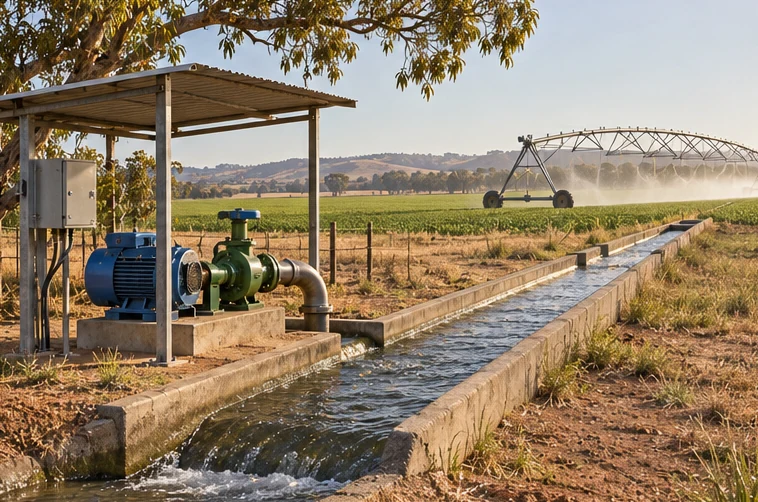
Cover illustration by Industry Applied, generated with AI. Irrigation pump serving an open farm channel.
Related reading
Price water at the receiving point when comparing pumping windows. Paying less per kilowatt-hour can still cost more per delivered megalitre if fewer of the pumped litres reach the field. Use measured delivery volumes for both windows and match each to the energy consumed.
Put two farm runs on the same basis
In an illustrative Australian channel system, a daytime run pumps 1.00 ML using 110 kWh at $0.30/kWh. The field inlet records 0.90 ML. The run costs $33, or $36.67 per delivered ML. A night run uses the same 110 kWh at $0.24/kWh and costs $26.40. If 0.75 ML reaches the field, that is $35.20/ML. The night run wins narrowly, even though its electricity price was 20% lower.
Worked data
Run | Water at field inlet (ML) | Electricity per delivered ML (A$) |
Day | 0.90 | 36.67 |
Night, case A | 0.75 | 35.20 |
Night, case B | 0.65 | 40.62 |
Download the figures in this worked example (CSV)
Find the point that changes the decision
Divide $26.40 by the daytime benchmark of $36.67/ML. The night run must deliver roughly 0.72 ML to break even on electricity alone. That threshold is useful when reliable transfer data are still being collected. It also makes the contract question precise: are the two rates actually available at the start and end of each run?
Follow a complete delivery through the channel. Water leaving the pump before midnight may reach the field the following morning. Recording outlet readings only until the pump stops undervalues a slow delivery. Compare similar starting channel levels, document tailwater and allow for measurement uncertainty. NSW pump performance guidance gives a basis for measuring energy and pumped volume. The downstream delivery account adds the part a pump-only audit misses.
A low-cost run can still miss the irrigation requirement
Suppose the crop plan calls for 0.90 ML at the inlet. In the night case delivering 0.75 ML per pump run, it takes the equivalent of 1.20 such runs to deliver the target, assuming losses scale in proportion. At 110 kWh per run the energy becomes 132 kWh, costing $31.68. Day delivery costs $33. The saving for the same water at the same location is $1.32. Comparing $26.40 with $33 overstates the commercial opportunity because the two runs supplied different quantities.
The proportional assumption is easy to break. A dry channel can take up water at the start of a delivery, leaving a different marginal loss once the bed is wetted. A second part-run may also incur a minimum charge or a longer period outside the preferred tariff. Use a complete event covering the desired volume if the saving is this small.
A paddock record that contains both meter serials, start and finish times, the rate window and the channel condition lets the irrigator repeat the comparison at the next turn. Where no receiving meter exists, label the delivery fraction as an estimate and carry the 0.72 ML break-even threshold into the decision.
Sources
NSW Department of Primary Industries · Electric pumps, performance and efficiency
Cover illustration by Industry Applied, generated with AI. Irrigation pump serving an open farm channel.