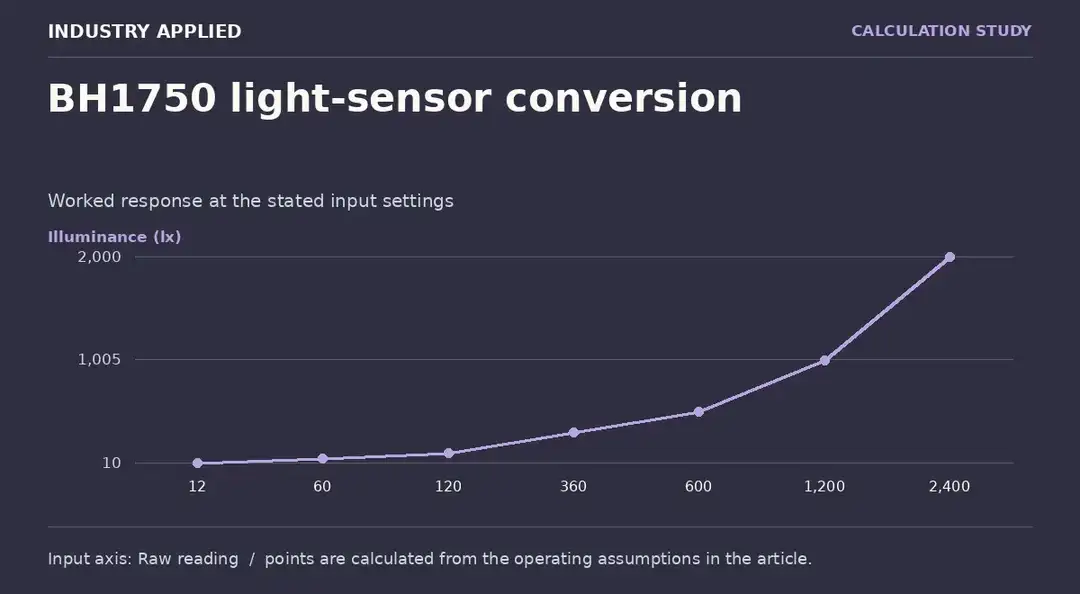
For this worked conversion use the normal scale and a transmittance factor of one. The binding divides the raw result by 1.2 times the transmittance factor. Mode and optical window are part of the measurement configuration. With raw reading at 360, the worked result is 300 on the illuminance (lx) scale.
The recorded quantity and the calculated result
Keep three columns in a commissioning export: the original raw reading, the configuration used in the conversion and the resulting illuminance (lx). Recompute the result for the lower, middle and upper worked points before interpreting a field difference. A change in range, units or representation can otherwise be mistaken for a change in the process.
Two points to check independently
Take the neighbouring worked points 120 and 360 on the input axis. The results are 100 and 300, giving a signed difference of 200. The table preserves the calculated values before display rounding. These are calculated examples under the stated assumptions. They are not readings from a ProSense installation.
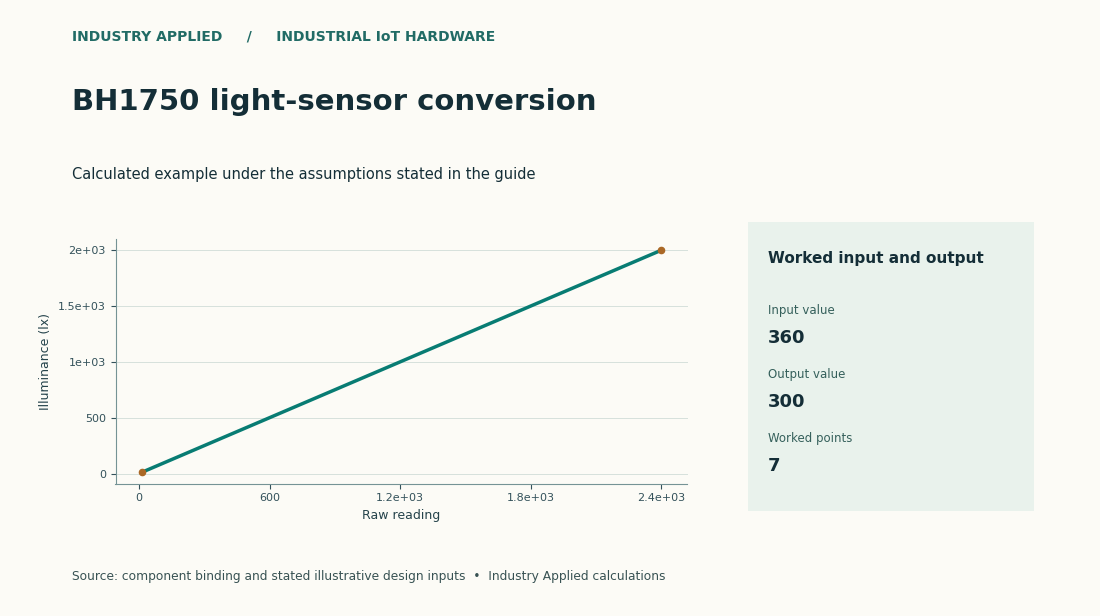
Worked data
Raw reading | Illuminance (lx) |
|---|---|
12 | 10 |
60 | 50 |
120 | 100 |
360 | 300 |
600 | 500 |
1200 | 1000 |
2400 | 2000 |
Checking the ends of the working range
The final interval in this example runs from 360 to 2,400 on the raw reading axis. Its average change in illuminance (lx) per input unit is 0.8333. This is a two-point slope for that interval. To check a spreadsheet or a gateway calculation, enter 2,400 in a separate test row and compare its result against 2,000 at the displayed precision.
Installation and interpretation
A protective cover can attenuate light. Check the configured optical factor and measurement mode before comparing a bare sensor with an enclosed field installation. A digital code alone does not measure the spectral mismatch of two instruments.
For a repeatable verification, capture a small known case and a second case well away from it. Check whether the difference follows the response in the table, then restore the working configuration and repeat one reading. Store a separate status field for missing or invalid input. Substituting zero would make a dropped observation indistinguishable from a legitimate numerical zero.
Implementation and worked data
The source implementation is maintained in the .NET IoT device project. The component notes and manufacturer references document the supported device and its interfaces. Download the worked numerical example.