
Industrial Automation
A barcode reads after three tries. What should the line report?
Separate first-pass scan performance, eventual read rate and formal symbol verification using a 200-carton packaging run.
Count a carton once when it first enters the reading station. If it reads only on a second pass, it belongs in the eventual success total and in the first-pass failure record. Counting every trigger pulse as another carton makes performance depend on scanner settings as much as print quality.
Reconcile the cartons before the reads
Imagine 200 cartons entering a despatch trial. The reader decodes 184 on the first presentation. Staff recover 12 on a second presentation and three on a third. One still requires manual identification. First-pass performance is 184/200, or 92%. Eventual automatic reading is 199/200, or 99.5%. Reporting only 99.5% hides 16 interventions or repeat presentations.

Worked data
Outcome | Share of 200 cartons | Cartons |
First presentation | 92.0% | 184 |
Second presentation | 6.0% | 12 |
Third presentation | 1.5% | 3 |
Manual identification | 0.5% | 1 |
Download the figures in this worked example (CSV)
Send the right evidence to the right person
Save the physical samples or labelled images of failures. Compare failures from the same print batch across different reader positions and compare two batches at the same position. A strong position effect points to a different investigation from a weak symbol repeated across several stations. Record line speed, orientation, substrate and print batch before a shift change removes the context.
GS1 Australia’s Barcode Check service evaluates properties of a symbol that a successful read by one device cannot establish. An unusually good verification report also cannot tell you whether a particular conveyor presents each carton within the scanner’s field. Use a line trial to measure throughput and interventions. Use verification when the question concerns symbol quality or conformance. Keeping both records often shortens disagreements between the printer and the warehouse.
Sources
GS1 Australia · Barcode Check and verification
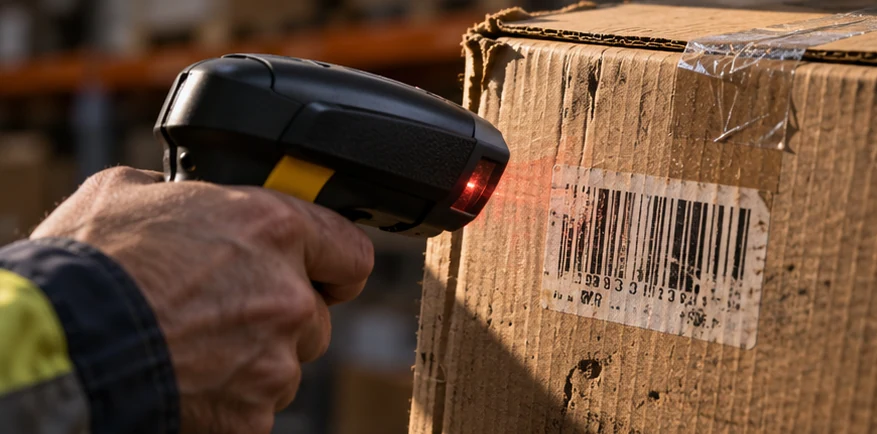
Cover illustration by Industry Applied, generated with AI. Handheld scanner reading a symbol printed on corrugated board.
Related reading
Count a carton once when it first enters the reading station. If it reads only on a second pass, it belongs in the eventual success total and in the first-pass failure record. Counting every trigger pulse as another carton makes performance depend on scanner settings as much as print quality.
Reconcile the cartons before the reads
Imagine 200 cartons entering a despatch trial. The reader decodes 184 on the first presentation. Staff recover 12 on a second presentation and three on a third. One still requires manual identification. First-pass performance is 184/200, or 92%. Eventual automatic reading is 199/200, or 99.5%. Reporting only 99.5% hides 16 interventions or repeat presentations.
Worked data
Outcome | Share of 200 cartons | Cartons |
First presentation | 92.0% | 184 |
Second presentation | 6.0% | 12 |
Third presentation | 1.5% | 3 |
Manual identification | 0.5% | 1 |
Download the figures in this worked example (CSV)
Send the right evidence to the right person
Save the physical samples or labelled images of failures. Compare failures from the same print batch across different reader positions and compare two batches at the same position. A strong position effect points to a different investigation from a weak symbol repeated across several stations. Record line speed, orientation, substrate and print batch before a shift change removes the context.
GS1 Australia’s Barcode Check service evaluates properties of a symbol that a successful read by one device cannot establish. An unusually good verification report also cannot tell you whether a particular conveyor presents each carton within the scanner’s field. Use a line trial to measure throughput and interventions. Use verification when the question concerns symbol quality or conformance. Keeping both records often shortens disagreements between the printer and the warehouse.
Sources
GS1 Australia · Barcode Check and verification
Cover illustration by Industry Applied, generated with AI. Handheld scanner reading a symbol printed on corrugated board.