
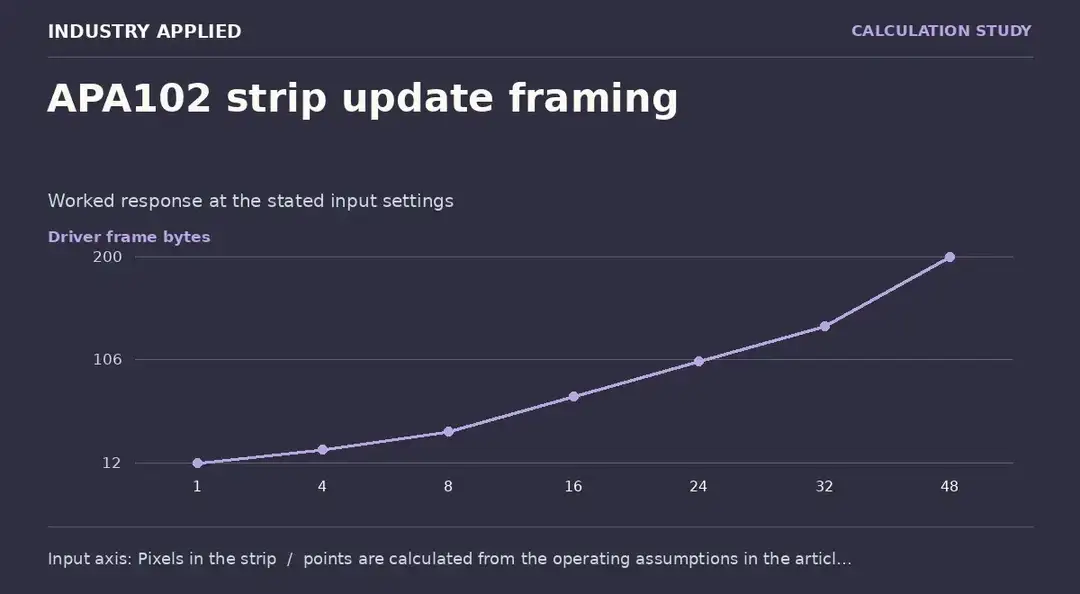
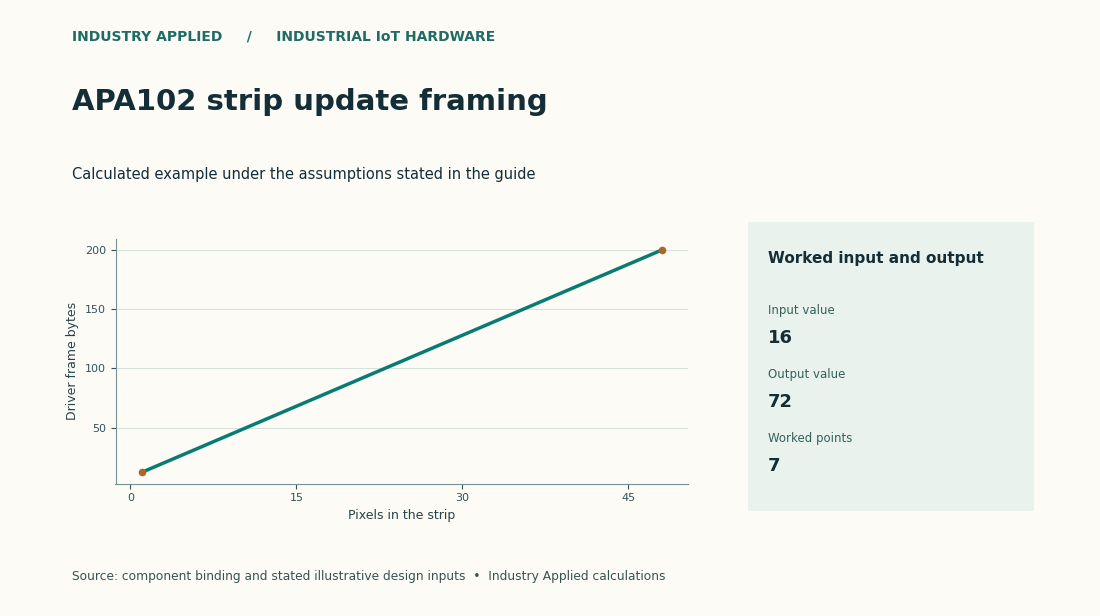
The documented implementation allocates four start bytes, four bytes per pixel and four ending bytes. This calculation describes the transfer format in that implementation. Preserve the driver revision when comparing it with another LED strip controller. In the worked example, Pixels in the strip 16 gives driver frame bytes of 72.
The recorded quantity and the calculated result
Keep three columns in a commissioning export: the original pixels in the strip, the configuration used in the conversion and the resulting driver frame bytes. Recompute the result for the lower, middle and upper worked points before interpreting a field difference. A change in range, units or representation can otherwise be mistaken for a change in the process.
Two points to check independently
At 8 the calculated driver frame bytes is 40. At 16 it is 72. Subtracting the first output from the second gives 32. These values give two independent checkpoints for a spreadsheet or a logger conversion.
Worked data
Pixels in the strip | Driver frame bytes |
|---|---|
1 | 12 |
4 | 24 |
8 | 40 |
16 | 72 |
24 | 104 |
32 | 136 |
48 | 200 |
Checking the ends of the working range
The interval from the middle to the upper test point runs from 16 to 48 on the pixels in the strip axis. Its average change in driver frame bytes per input unit is 4. This is a two-point slope for that interval. To check a spreadsheet or a gateway calculation, enter 48 in a separate test row and compare its result against 200 at the displayed precision.
Installation and interpretation
Different controllers and long chains may require different end framing. Compare a captured transfer with the exact driver used and count data as well as framing. Pixel count alone does not give the complete message length.
For a repeatable verification, capture a small known case and a second case well away from it. Check whether the difference follows the response in the table, then restore the working configuration and repeat one reading. Store a separate status field for missing or invalid input. Substituting zero would make a dropped observation indistinguishable from a legitimate numerical zero.
Implementation and worked data
The source implementation is maintained in the .NET IoT device project. The component notes and manufacturer references document the supported device and its interfaces. Download the worked numerical example.