
Agricultural Technology
Four trays of seed give different counts. Which germination figure travels with the lot?
Pool the actual seeds tested, examine the spread between trays and keep the germination result separate from expected field establishment.
Pool the number of acceptable germinated seeds and the number tested, keeping the individual tray results. Four equal trays let you take a simple mean of the percentages. Unequal sample sizes make that shortcut unreliable. Just as important, a tidy average can hide an unusual tray that tells you something about the sample or the test.
Count a deliberately uneven test
Suppose three trays hold 50 seeds each and a fourth holds 25. They produce 46, 44, 45 and 15 acceptable seedlings. The pooled result is 150/175, or 85.7%. An equal average of the four tray percentages is 82.5%. It gives the small, weak tray twice the weight it deserves for estimating the tested proportion.

Worked data
Tray | Acceptable seedlings / tested | Germination (%) |
A | 46 / 50 | 92 |
B | 44 / 50 | 88 |
C | 45 / 50 | 90 |
D | 15 / 25 | 60 |
Download the figures in this worked example (CSV)
Investigate the weak tray
Compare the sampling location, temperature, moisture and assessment date for D with the other trays. If it came from a separate lot, pooling may be inappropriate. If it shared the lot but dried at one edge, the result may tell you more about the test environment than the seed. Keep the original result and document any repeat using the appropriate crop protocol. Discarding an inconvenient tray without an explanation biases the record.
Agriculture Victoria explains germination and vigour testing before sowing. A bench result describes seeds under the chosen test conditions. Field establishment also depends on seedbed, sowing conditions and subsequent weather. For formal certification, seed trading or substitution decisions, use the sampling and testing requirements that apply to the crop and contract.
Sources
Agriculture Victoria · Testing crop seed for sowing
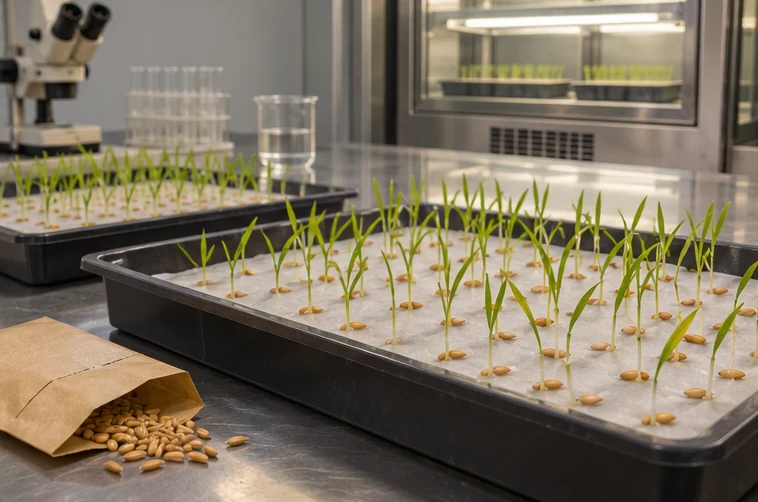
Cover illustration by Industry Applied, generated with AI. Seedlings emerging in germination trays.
Related reading
Pool the number of acceptable germinated seeds and the number tested, keeping the individual tray results. Four equal trays let you take a simple mean of the percentages. Unequal sample sizes make that shortcut unreliable. Just as important, a tidy average can hide an unusual tray that tells you something about the sample or the test.
Count a deliberately uneven test
Suppose three trays hold 50 seeds each and a fourth holds 25. They produce 46, 44, 45 and 15 acceptable seedlings. The pooled result is 150/175, or 85.7%. An equal average of the four tray percentages is 82.5%. It gives the small, weak tray twice the weight it deserves for estimating the tested proportion.
Worked data
Tray | Acceptable seedlings / tested | Germination (%) |
A | 46 / 50 | 92 |
B | 44 / 50 | 88 |
C | 45 / 50 | 90 |
D | 15 / 25 | 60 |
Download the figures in this worked example (CSV)
Investigate the weak tray
Compare the sampling location, temperature, moisture and assessment date for D with the other trays. If it came from a separate lot, pooling may be inappropriate. If it shared the lot but dried at one edge, the result may tell you more about the test environment than the seed. Keep the original result and document any repeat using the appropriate crop protocol. Discarding an inconvenient tray without an explanation biases the record.
Agriculture Victoria explains germination and vigour testing before sowing. A bench result describes seeds under the chosen test conditions. Field establishment also depends on seedbed, sowing conditions and subsequent weather. For formal certification, seed trading or substitution decisions, use the sampling and testing requirements that apply to the crop and contract.
Sources
Agriculture Victoria · Testing crop seed for sowing
Cover illustration by Industry Applied, generated with AI. Seedlings emerging in germination trays.