
Agricultural Technology
Which day did the rain fall on? Matching a farm logger to the Bureau
Rebuild the Bureau of Meteorology’s 9 am reporting period from timestamped observations before treating a daily total as a gauge error.
Compare like observation periods before sending a rain gauge for calibration. A calendar-day logger closes its record at midnight. A conventional Australian daily rainfall observation covers the 24 hours ending at 9 am local observation time and is attributed to the day on which that period ends. An overnight shower can move between dates without a drop of water going missing.
Move four readings into the right day
Imagine 3 mm at 11 pm on Monday, 5 mm at 2 am on Tuesday and 4 mm at 8:30 am on Tuesday. Another 2 mm falls at 10 am Tuesday. With no other rain in either window, the midnight-to-midnight Tuesday total is 11 mm. The Tuesday 9 am observation contains Monday’s 3 mm plus the two early Tuesday falls, giving 12 mm. The 10 am shower belongs in Wednesday’s 9 am observation.

Worked data
Report ending | Events included (mm) | Rainfall (mm) |
Tuesday 9 am | 3 + 5 + 4 | 12 |
Tuesday midnight | 5 + 4 + 2 | 11 |
Wednesday 9 am | 2 only | 2 |
Download the figures in this worked example (CSV)
Find the convention in the export
A date-only CSV cannot tell you when during the day the rain fell. Obtain the finer observations or the logger’s tip timestamps to reconstruct the comparison. Confirm the station’s actual observation notes, the time basis of the downloaded product and the local offset, particularly where daylight saving applies. Retain the raw times before converting them.
Missing or accumulated observations need a separate flag. Spreading a multi-day recorded total evenly over several days manufactures timing the source did not observe. For an irrigation review, keep the farm-operational day if it helps decision-making, and produce a separate comparison series under the Bureau’s convention. Both can be valid when their boundaries are visible.
A one-millimetre discrepancy can conceal a bigger timing error
In the example, the two headline daily totals differ by just 1 mm. Yet 3 mm moved into the comparison window on Monday night and 2 mm moved out on Tuesday after 9 am. Offsetting movements can make a badly aligned comparison look reassuringly good. Look at several consecutive days, including an isolated shower that clearly falls on one side of the boundary.
A tipping-bucket logger may timestamp the instant each accumulated tip occurs. A manually observed daily entry represents a block of elapsed time. Preserve the distinction when importing both into one database. If a logger stores only whole-hour totals, the hour straddling the chosen cut-off may need treatment consistent with the logger’s own interval labelling. A timestamp of 09:00 can identify either the preceding hour or the following one.
For a farm manager, the useful output can be two columns with different labels: rainfall in the farm workday and rainfall in the station observation day. Mark the source time zone, cut-off and observation status in the export itself. Someone comparing records months later should not need access to the original logger’s setup screen.
Sources
Australian Bureau of Meteorology · About rainfall data
Australian Bureau of Meteorology · Definitions of rainfall statistics
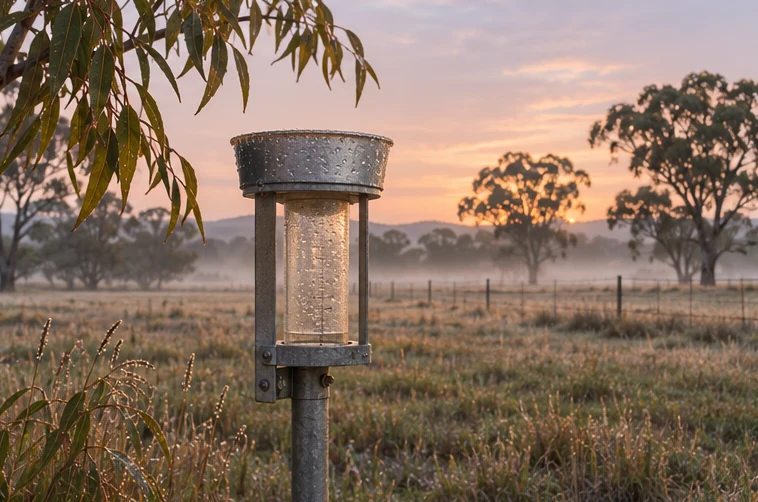
Cover illustration by Industry Applied, generated with AI. A paddock rain gauge at dawn.
Compare like observation periods before sending a rain gauge for calibration. A calendar-day logger closes its record at midnight. A conventional Australian daily rainfall observation covers the 24 hours ending at 9 am local observation time and is attributed to the day on which that period ends. An overnight shower can move between dates without a drop of water going missing.
Move four readings into the right day
Imagine 3 mm at 11 pm on Monday, 5 mm at 2 am on Tuesday and 4 mm at 8:30 am on Tuesday. Another 2 mm falls at 10 am Tuesday. With no other rain in either window, the midnight-to-midnight Tuesday total is 11 mm. The Tuesday 9 am observation contains Monday’s 3 mm plus the two early Tuesday falls, giving 12 mm. The 10 am shower belongs in Wednesday’s 9 am observation.
Worked data
Report ending | Events included (mm) | Rainfall (mm) |
Tuesday 9 am | 3 + 5 + 4 | 12 |
Tuesday midnight | 5 + 4 + 2 | 11 |
Wednesday 9 am | 2 only | 2 |
Download the figures in this worked example (CSV)
Find the convention in the export
A date-only CSV cannot tell you when during the day the rain fell. Obtain the finer observations or the logger’s tip timestamps to reconstruct the comparison. Confirm the station’s actual observation notes, the time basis of the downloaded product and the local offset, particularly where daylight saving applies. Retain the raw times before converting them.
Missing or accumulated observations need a separate flag. Spreading a multi-day recorded total evenly over several days manufactures timing the source did not observe. For an irrigation review, keep the farm-operational day if it helps decision-making, and produce a separate comparison series under the Bureau’s convention. Both can be valid when their boundaries are visible.
A one-millimetre discrepancy can conceal a bigger timing error
In the example, the two headline daily totals differ by just 1 mm. Yet 3 mm moved into the comparison window on Monday night and 2 mm moved out on Tuesday after 9 am. Offsetting movements can make a badly aligned comparison look reassuringly good. Look at several consecutive days, including an isolated shower that clearly falls on one side of the boundary.
A tipping-bucket logger may timestamp the instant each accumulated tip occurs. A manually observed daily entry represents a block of elapsed time. Preserve the distinction when importing both into one database. If a logger stores only whole-hour totals, the hour straddling the chosen cut-off may need treatment consistent with the logger’s own interval labelling. A timestamp of 09:00 can identify either the preceding hour or the following one.
For a farm manager, the useful output can be two columns with different labels: rainfall in the farm workday and rainfall in the station observation day. Mark the source time zone, cut-off and observation status in the export itself. Someone comparing records months later should not need access to the original logger’s setup screen.
Sources
Australian Bureau of Meteorology · About rainfall data
Australian Bureau of Meteorology · Definitions of rainfall statistics
Cover illustration by Industry Applied, generated with AI. A paddock rain gauge at dawn.