

Add up the alarms from each machine on a packaging line and a seven-minute filler stop plus an eight-minute packer stop looks like fifteen minutes lost. The same four minutes appear in both records. Decide what the shift report is measuring before you total anything.
Choose the point that defines production
For a finished-pack line, one useful boundary is accepted packs crossing the discharge counter. Record the first loss of expected output and the time normal output resumes, using the same criterion on every shift. Agree how changeovers, planned breaks and brief interruptions will be treated. A machine state can help explain missing output, but a buffer can let the line produce while an upstream machine is stopped.
Reconstruct an example
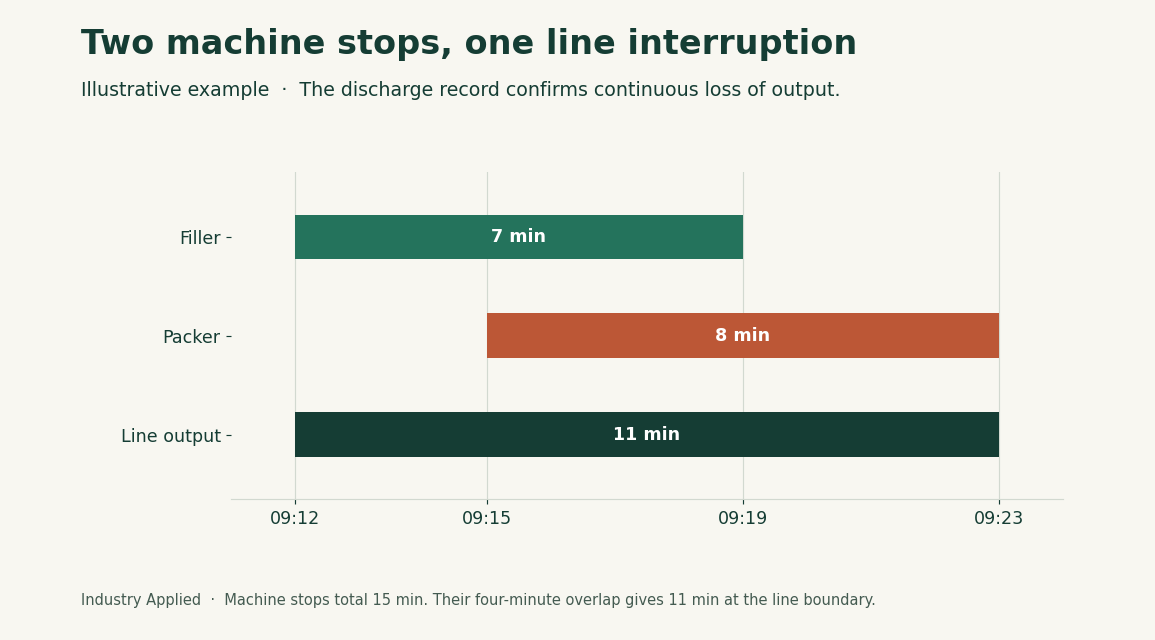
09:12 to 09:19 · Filler stopped for 7 minutes.
09:15 to 09:23 · Packer stopped for 8 minutes.
09:12 to 09:23 · The example discharge record confirms 11 minutes of continuous lost output.
Keep both machine events for maintenance and enter one 11-minute line event for the shift. The four overlapping minutes count once. If the discharge record instead shows the buffer sustained output until 09:15, the line loss is eight minutes. Machine alarm times alone cannot settle which figure is correct.
Calculate availability on the same boundary
Suppose the line was scheduled to produce for 420 minutes and the 11-minute event was its only counted stop. Run time is 409 minutes, so availability is 409 ÷ 420 × 100 = 97.4% to one decimal place. Availability is one factor in overall equipment effectiveness. Speed loss and rejected packs are separate inputs to the full calculation.
Give the next shift an auditable entry
Record the line, output boundary, start and finish, reason, supporting machine events, and the source of the timestamps. If the initiating cause is unknown, record that and assign a follow-up. A filler alarm and a starved packer are two clues to keep, even when they describe one interruption.
Decide what the accumulation buffer bought
For an Australian beverage packer, suppose the customer order calls for 120 accepted cartons a minute whenever the line is scheduled to run. At that reference rate, 11 minutes represents 1,320 cartons of opportunity. Eight minutes represents 960. The difference, 360 cartons, is the three minutes of output the buffer could sustain in the second scenario. These are illustrative reference quantities. Use the discharge counter and rejects for the actual good-carton count.
The two explanations lead to different decisions. If the discharge stopped immediately with the filler, investigate why the intended accumulation was unavailable. If three minutes of output continued, the buffer performed a measurable service. Compare the production saved with the space and handling cost before asking for a larger buffer. The machine fault record by itself cannot tell you how much accumulation was available.
Handle an interruption that crosses a shift boundary
Treat the start of an interval as included and its end as the instant production resumes. For a confirmed six-minute stop from 13:58 to 14:04, a shift ending at 14:00 carries two minutes and the incoming shift carries four. Keep one incident identifier across the handover. The daily total then reconciles to six minutes while each shift report uses its own scheduled production time.
Record the time basis and granularity of the counter. A system that reports only minute totals may show a partly productive minute at each edge. If the log cannot locate the stop more precisely, keep the uncertainty in the shift note. For a short repeated interruption, event-level timestamps can change the case for a maintenance repair.
Source
Vorne · Calculating OEE, including availability and planned production time