
Agricultural Technology
How long before new water reaches the far end of an irrigation main?
Use the internal bore and measured through-flow to estimate transit time, then account for branches, mixing and changes in the operating flow.
A full 400 m main with a 100 mm internal diameter contains approximately 3.14 kL. At a steady 10 L/s through the full length, one pipe-volume transit takes about 314 seconds, or 5.24 minutes. That is a reference time for an idealised moving volume. It does not certify that every drop at the outlet has been replaced.
Work from the bore rather than the nominal size
Volume is π × diameter²/4 × length. Using metres gives cubic metres, each equal to 1,000 litres. Write down the internal diameter from the applicable pipe series. If a nominal 100 mm line actually has a 90 mm bore, the calculated inventory falls to roughly 2.54 kL. At 10 L/s the time drops to 4.24 minutes. A ten-percent change in bore has a much larger proportional effect on volume.

Worked data
Measured flow (L/s) | Volume / flow (seconds) | Reference time (min) |
5 | 628.3 | 10.47 |
10 | 314.2 | 5.24 |
15 | 209.4 | 3.49 |
Download the figures in this worked example (CSV)
When one flow reading is the wrong input
A meter at the pump includes flow diverted to laterals upstream of the far end. Each reach can have a different velocity. Divide the line into reaches, calculate each wetted volume and divide by its own through-flow. Add the travel times along the path to the observation point.
Early arrival of a change in conductivity or temperature and complete stabilisation are also different events. Mixing, dead legs and sensor response broaden the observed transition. For an irrigation changeover, retain observations from normal operations with time, flow, valve configuration and observation point. A reference volume is useful for anticipating when to start watching the outlet. Separate water-quality or treatment decisions call for their own verification.
Sources
Netafim Australia · Drip maintenance guide, pipe velocity and volume
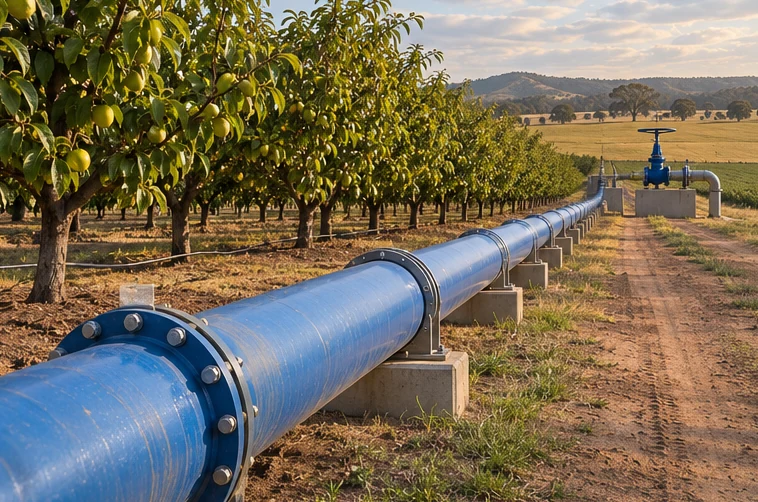
Cover illustration by Industry Applied, generated with AI. An irrigation main running along orchard rows.
A full 400 m main with a 100 mm internal diameter contains approximately 3.14 kL. At a steady 10 L/s through the full length, one pipe-volume transit takes about 314 seconds, or 5.24 minutes. That is a reference time for an idealised moving volume. It does not certify that every drop at the outlet has been replaced.
Work from the bore rather than the nominal size
Volume is π × diameter²/4 × length. Using metres gives cubic metres, each equal to 1,000 litres. Write down the internal diameter from the applicable pipe series. If a nominal 100 mm line actually has a 90 mm bore, the calculated inventory falls to roughly 2.54 kL. At 10 L/s the time drops to 4.24 minutes. A ten-percent change in bore has a much larger proportional effect on volume.
Worked data
Measured flow (L/s) | Volume / flow (seconds) | Reference time (min) |
5 | 628.3 | 10.47 |
10 | 314.2 | 5.24 |
15 | 209.4 | 3.49 |
Download the figures in this worked example (CSV)
When one flow reading is the wrong input
A meter at the pump includes flow diverted to laterals upstream of the far end. Each reach can have a different velocity. Divide the line into reaches, calculate each wetted volume and divide by its own through-flow. Add the travel times along the path to the observation point.
Early arrival of a change in conductivity or temperature and complete stabilisation are also different events. Mixing, dead legs and sensor response broaden the observed transition. For an irrigation changeover, retain observations from normal operations with time, flow, valve configuration and observation point. A reference volume is useful for anticipating when to start watching the outlet. Separate water-quality or treatment decisions call for their own verification.
Sources
Netafim Australia · Drip maintenance guide, pipe velocity and volume
Cover illustration by Industry Applied, generated with AI. An irrigation main running along orchard rows.