Industrial IoT
Stop daylight saving from moving a factory event to the wrong day
Adelaide and Auckland use different UTC offsets. A shift log can preserve the instant and still report it against the local production day.

A support team in Adelaide investigates a fault recorded by an Auckland plant. Both screens say Thursday, but the daily production extract has placed the first Auckland shift events on Wednesday. A time-zone suffix and an explicit reporting boundary solve different parts of this problem.
Preserve the instant and name the reporting zone
Use an unambiguous instant for exchange, such as a UTC timestamp, and retain the original offset when available. Keep the named plant time zone for local reporting. A fixed numeric offset describes an instant but does not contain a location’s future and historical daylight-saving rules. Decide separately whether the production day starts at midnight or at a shift boundary.
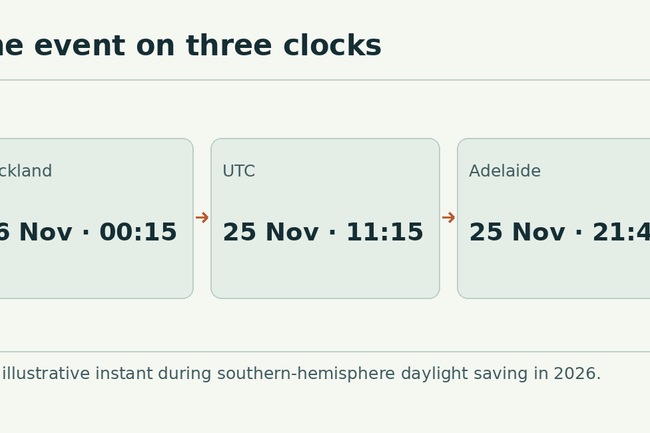
At 00:15 on 26 November 2026 in Auckland, the local offset is +13:00. The instant is 11:15 UTC on 25 November. In Adelaide, then at +10:30, it is 21:45 on 25 November. Two different local calendar dates correctly describe the same event.
What to check on site
Test midnight and both ends of the daylight-saving season with known instants.
Retain the source instant when an operator edits a report label.
Apply the plant’s shift boundary after converting to its named time zone.
Cross-site reports can use UTC for sorting while printing the local shift date alongside it. A twenty-four-hour local label also needs care on the days when clocks advance or repeat.
Sources and photograph
Reserve Bank of Australia — daylight saving times
A support team in Adelaide investigates a fault recorded by an Auckland plant. Both screens say Thursday, but the daily production extract has placed the first Auckland shift events on Wednesday. A time-zone suffix and an explicit reporting boundary solve different parts of this problem.
Preserve the instant and name the reporting zone
Use an unambiguous instant for exchange, such as a UTC timestamp, and retain the original offset when available. Keep the named plant time zone for local reporting. A fixed numeric offset describes an instant but does not contain a location’s future and historical daylight-saving rules. Decide separately whether the production day starts at midnight or at a shift boundary.
At 00:15 on 26 November 2026 in Auckland, the local offset is +13:00. The instant is 11:15 UTC on 25 November. In Adelaide, then at +10:30, it is 21:45 on 25 November. Two different local calendar dates correctly describe the same event.
What to check on site
Test midnight and both ends of the daylight-saving season with known instants.
Retain the source instant when an operator edits a report label.
Apply the plant’s shift boundary after converting to its named time zone.
Cross-site reports can use UTC for sorting while printing the local shift date alongside it. A twenty-four-hour local label also needs care on the days when clocks advance or repeat.
Sources and photograph
Reserve Bank of Australia — daylight saving times