
Industrial IoT
A flow trace disappears for six minutes. How much water is unaccounted for?
Bound missing transfer volume from elapsed time and a defensible operating range before choosing whether to interpolate the historian gap.
A six-minute gap in a flow trace contains an unknown volume. If independent process evidence places the flow between 2 and 8 L/s throughout the gap, 720 to 2,880 litres could have passed. Entering a zero converts a missing measurement into an assertion that the transfer stopped.
Put lower and upper bounds on the gap
There are 360 seconds in six minutes. Multiplying by the two justified flow limits gives 0.72 and 2.88 kL. A straight-line estimate between endpoint readings of 3 and 7 L/s would use a 5 L/s mean and return 1.80 kL. That point estimate is plausible if the transition was approximately linear. The two endpoint readings alone cannot establish the path between them.

Worked data
Interpretation | Flow assumed (L/s) | Gap volume (kL) |
Lower bound | 2 | 0.72 |
Linear estimate | 5 | 1.80 |
Upper bound | 8 | 2.88 |
Download the figures in this worked example (CSV)
Find a second record
A cumulative meter reading across the outage can constrain the volume far more tightly. Check that the totaliser did not reset and that its measurement boundary matches the flow tag. A valve indication or pump command may support a range, but the command alone does not prove the actual flow. If backflow is possible, a zero lower bound may itself be unjustified.
Keep the measured subtotal and the estimated portion separate. Report the gap start, end, bounding evidence and estimation method. The OGC SensorThings model distinguishes an observation and its time of occurrence. That distinction helps a data pipeline carry an estimate alongside the observed record. For an Australian water transfer report, it also allows a reviewer to recompute the range if better evidence arrives.
Sources
Open Geospatial Consortium · SensorThings API, Sensing 1.1
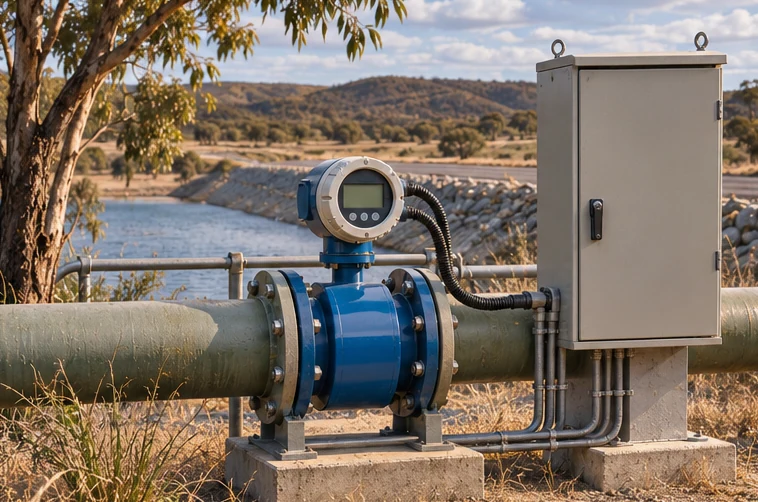
Cover illustration by Industry Applied, generated with AI. An industrial flowmeter beside a monitoring cabinet.
Related reading
A six-minute gap in a flow trace contains an unknown volume. If independent process evidence places the flow between 2 and 8 L/s throughout the gap, 720 to 2,880 litres could have passed. Entering a zero converts a missing measurement into an assertion that the transfer stopped.
Put lower and upper bounds on the gap
There are 360 seconds in six minutes. Multiplying by the two justified flow limits gives 0.72 and 2.88 kL. A straight-line estimate between endpoint readings of 3 and 7 L/s would use a 5 L/s mean and return 1.80 kL. That point estimate is plausible if the transition was approximately linear. The two endpoint readings alone cannot establish the path between them.
Worked data
Interpretation | Flow assumed (L/s) | Gap volume (kL) |
Lower bound | 2 | 0.72 |
Linear estimate | 5 | 1.80 |
Upper bound | 8 | 2.88 |
Download the figures in this worked example (CSV)
Find a second record
A cumulative meter reading across the outage can constrain the volume far more tightly. Check that the totaliser did not reset and that its measurement boundary matches the flow tag. A valve indication or pump command may support a range, but the command alone does not prove the actual flow. If backflow is possible, a zero lower bound may itself be unjustified.
Keep the measured subtotal and the estimated portion separate. Report the gap start, end, bounding evidence and estimation method. The OGC SensorThings model distinguishes an observation and its time of occurrence. That distinction helps a data pipeline carry an estimate alongside the observed record. For an Australian water transfer report, it also allows a reviewer to recompute the range if better evidence arrives.
Sources
Open Geospatial Consortium · SensorThings API, Sensing 1.1
Cover illustration by Industry Applied, generated with AI. An industrial flowmeter beside a monitoring cabinet.