
Industrial IoT
A meter restarted at zero. What part of the shift total can you recover?
Divide a cumulative series into separate counter lifetimes and label the unobserved interval across the restart. A lower bound can be more useful than a false total.
A falling cumulative meter reading can mark a restart or replacement. Subtract within a confirmed counter lifetime and keep the cross-restart interval separate. If the previous counter read 1,010 and the restarted counter reads three, subtracting the two produces a large negative value with no physical meaning for a forward-only meter.
Reconcile the visible increments
A workshop’s counter reads 1,000 at 09:00 and 1,010 at 09:05. A documented reset to zero occurs before the 09:10 reading of three. At 09:15 the count is nine. The observed movement from 09:00 to 09:05 contributes ten. The new lifetime contributes nine from its known zero to 09:15. The shift therefore has at least 19 counts plus any unobserved increase between the last old reading and the reset.

Worked data
Confirmed interval | Difference used | Known counts |
Old counter to 09:05 | 1,010 − 1,000 | 10 |
New zero to 09:10 | 3 − 0 | 3 |
09:10 to 09:15 | 9 − 3 | 6 |
Download the figures in this worked example (CSV)
Distinguish reset, replacement and wrap
Retain the device identity, boot or start time, units and any counter modulus. A wrapping register has a different reconstruction rule from a device replaced halfway through a shift. A register falling from 999 to 3 is ambiguous until those facts are known. A bidirectional quantity can also legitimately decrease.
OpenTelemetry’s metrics data model distinguishes cumulative and delta temporality and explains why start timestamps matter when a stream restarts. Put this evidence beside the production record. If the outgoing meter’s final retained value is later recovered, add the missing old-lifetime increment and flag the revision. Otherwise the lower bound is an honest result a customer can audit.
Work out whether the unknown portion matters to the shift
Imagine an independent production record confirms that the line could add no more than two counts per minute, and the gap between the final old reading and the restart was at most two minutes. The missing increment is bounded between zero and four. The shift record can then state 19 to 23 counts for the period. If the line could continue faster, or the restart time is unknown, that tighter interval has no evidential basis.
For a production reconciliation, ask whether a dispatch scan, local batch report or mechanical register survived the reboot. These are useful only when their unit boundary matches the counter. A carton counter upstream of a reject station is a poor substitute for a good-product counter downstream unless the rejected cartons are also identified. The discrepancy between the sources may reveal their different definitions more clearly than it reveals the missing quantity.
Separate the counter's configured lifetime from the historian tag name. A replacement device may inherit an old tag name and engineering unit while starting a completely new count. Saving an installation or serial identifier and an explicit reset marker makes later exports intelligible, even if the trend screen continues to display one continuous tag.
Sources
OpenTelemetry · Metrics data model, temporality and resets
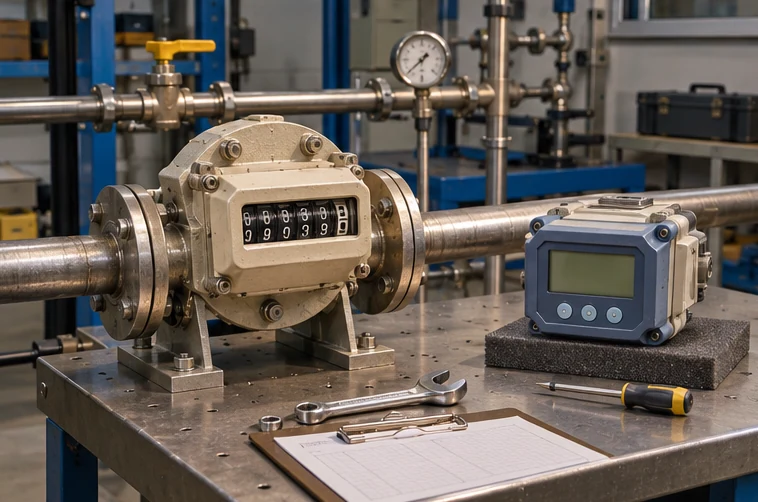
Cover illustration by Industry Applied, generated with AI. A meter totaliser and a replacement module.
A falling cumulative meter reading can mark a restart or replacement. Subtract within a confirmed counter lifetime and keep the cross-restart interval separate. If the previous counter read 1,010 and the restarted counter reads three, subtracting the two produces a large negative value with no physical meaning for a forward-only meter.
Reconcile the visible increments
A workshop’s counter reads 1,000 at 09:00 and 1,010 at 09:05. A documented reset to zero occurs before the 09:10 reading of three. At 09:15 the count is nine. The observed movement from 09:00 to 09:05 contributes ten. The new lifetime contributes nine from its known zero to 09:15. The shift therefore has at least 19 counts plus any unobserved increase between the last old reading and the reset.
Worked data
Confirmed interval | Difference used | Known counts |
Old counter to 09:05 | 1,010 − 1,000 | 10 |
New zero to 09:10 | 3 − 0 | 3 |
09:10 to 09:15 | 9 − 3 | 6 |
Download the figures in this worked example (CSV)
Distinguish reset, replacement and wrap
Retain the device identity, boot or start time, units and any counter modulus. A wrapping register has a different reconstruction rule from a device replaced halfway through a shift. A register falling from 999 to 3 is ambiguous until those facts are known. A bidirectional quantity can also legitimately decrease.
OpenTelemetry’s metrics data model distinguishes cumulative and delta temporality and explains why start timestamps matter when a stream restarts. Put this evidence beside the production record. If the outgoing meter’s final retained value is later recovered, add the missing old-lifetime increment and flag the revision. Otherwise the lower bound is an honest result a customer can audit.
Work out whether the unknown portion matters to the shift
Imagine an independent production record confirms that the line could add no more than two counts per minute, and the gap between the final old reading and the restart was at most two minutes. The missing increment is bounded between zero and four. The shift record can then state 19 to 23 counts for the period. If the line could continue faster, or the restart time is unknown, that tighter interval has no evidential basis.
For a production reconciliation, ask whether a dispatch scan, local batch report or mechanical register survived the reboot. These are useful only when their unit boundary matches the counter. A carton counter upstream of a reject station is a poor substitute for a good-product counter downstream unless the rejected cartons are also identified. The discrepancy between the sources may reveal their different definitions more clearly than it reveals the missing quantity.
Separate the counter's configured lifetime from the historian tag name. A replacement device may inherit an old tag name and engineering unit while starting a completely new count. Saving an installation or serial identifier and an explicit reset marker makes later exports intelligible, even if the trend screen continues to display one continuous tag.
Sources
OpenTelemetry · Metrics data model, temporality and resets
Cover illustration by Industry Applied, generated with AI. A meter totaliser and a replacement module.