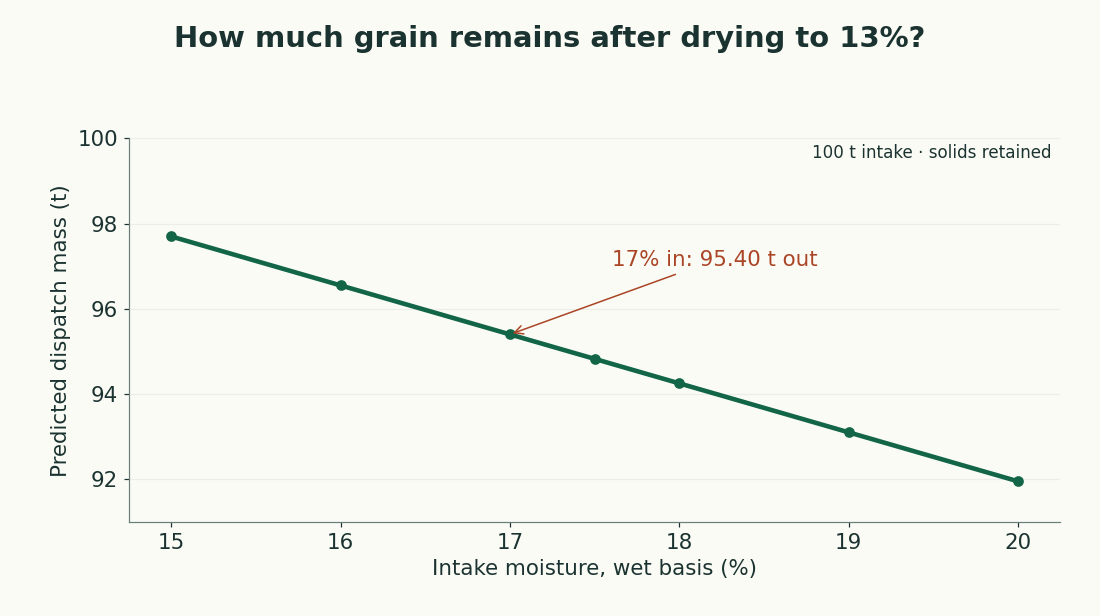
A 100-tonne parcel of grain at 17% moisture contains 83 tonnes of dry matter. If that dry matter is all retained, drying it to 13% leaves 95.40 tonnes on the weighbridge. About 4.60 tonnes of water have left. The four-percentage-point change in the moisture reading is a different quantity from the percentage change in the weight of the parcel. That distinction matters when a grower reconciles a dryer run or compares two bids for the same grain.
Follow the dry matter through the dryer
Grain moisture is commonly quoted on a wet basis. Divide the mass of water by the mass of the whole sample. At 17% moisture, every 100 kg of incoming grain contains 17 kg of water and 83 kg of dry material. At the 13% target each 100 kg contains 87 kg of dry material. The amount of grain that can contain the original 83 tonnes of solids is therefore 83 ÷ 0.87. The same arithmetic works in kilograms or tonnes if both weighings use the same unit.
A useful spreadsheet expression is final tonnes = incoming tonnes × (100 − incoming moisture %) ÷ (100 − final moisture %). Enter 17 and 13 when using the equation in this form. Where a spreadsheet cell stores 17% as 0.17, use 1 in place of 100. Check a row where inlet and outlet moisture are equal. It should return exactly the original tonnage.
What a weighbridge discrepancy means
Consider a hypothetical Riverina drying job. The intake docket reads 100.00 t at 17.0%, and the dispatch docket reads 94.90 t at 13.0%. At dispatch the implied dry matter is 94.90 × 0.87 = 82.563 t. Compare that with 83.000 t on arrival. The apparent dry-matter difference is 0.437 t, or about 0.53% of initial solids. Part of that could be screenings, dust, grain remaining in equipment, samples from different portions of a mixed lot or weighing uncertainty. The figures alone cannot distinguish those causes.
A single moisture result can dominate this reconciliation. Changing the assumed intake moisture from 17.0% to 17.5%, while holding the other inputs fixed, changes the expected delivery from 95.40 t to 94.83 t. That shift of 0.57 t is larger than the unexplained difference on the original dockets. Before investigating the dryer for a loss, check which samples reached the meter, the crop setting used and whether the scale readings cover the same lot.
Keep a usable lot record
Record the intake and dispatch docket numbers, commodity, sample collection method, measured moisture, scale identity and when each reading was taken. Capture screenings or other diverted streams on their own line.
Between dryer runs, check for carry-over into the next lot. Grain left in an auger changes a single-lot reconciliation even when the two-lot total balances.
Preserve the buyer’s moisture terms with the calculation. A commercial shrink schedule can include handling or a price adjustment. Its commercial deduction can differ from the water removed in the dryer.
Decide whether the calculation fits the decision
For dryer planning, use the water-loss estimate as an input to throughput and cost calculations. For a sale, compare the buyer’s payable tonnes, unit price, drying charge and freight for each offer. Keep the actual lot moisture and target in the record. An illustrative 13% target in this example is neither a receival limit nor a storage recommendation for a particular commodity.
South Dakota State University’s grain shrink calculation derives the wet-basis relationship. Grain Trade Australia’s sampling guideline provides Australian context for obtaining representative samples. Download the worked mass balance and sensitivity figures.
Cover photograph by Teodor Buhl, published under the Pexels licence. The worked figures and chart are by Industry Applied.